
Best of Their Times: Top 5 Dodgers of Each Decade Part 1
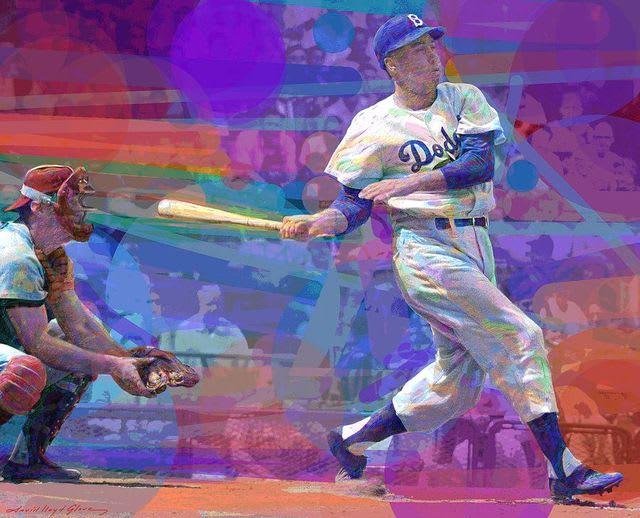
After my post about the top 24 players in Dodger history, Phil suggested that I break them down by the era in which they played. He opined that it would be interesting to see if Babe Ruth could hit the high velocity pitchers that are in the game now. He has a valid point. So many things in the game are different now. Players who were considered great defenders in the early days of the game, would be at the bottom of the list of defenders today. Many reasons for this, among them, the fields are manicured now and tended to around the year. Baseball gloves have evolved from something that was barely bigger than a person's hand, to gloves made for different positions. An outfielders glove now is generally larger than one used by an infielder.
Travel was different. Teams traveled by rail. Uniforms were made of wool, which in the summer heat would get soaked with perspiration. Dugouts and clubhouses were nothing like the posh places they are today. Lockers were metal and the players sat on stools. Diet and sport medicine as we know it today, were vastly different. Most players went to spring training to get into shape, now players show up ready to play. Another huge difference besides the pay, is the fact that every spring, a player was fighting to keep his job. There were no long-term contracts. Rookies were treated with distain because they were there to take your job. If you had a bad season, your pay could and usually was reduced for the following season. So, let's take a look back from 1900 and see who those players were who excelled in their times. Remember, there were no night games until the 30's and not all the stadiums had lights when they did start playing them. And remember that from 1900-1920 it was the dead ball era. Homers only became a real weapon in the 20's.
1900-1909
As the new century began, the professional team in Brooklyn was known as the Superbas. Named after a traveling performance group that was popular at that time. The 1900 version had four future Hall of Famers on their roster, Willie Keeler, Joe Kelley, Hughie Jennings, and Iron Joe McGinnity. None of those players would spend their entire career, or even large parts of it with Brooklyn. All of them were established players before they joined the team. When the American League came into existence in 1901, some Brooklyn stars jumped to the other league, including McGinnity and Kelley. These players are listed in no particular order. You will also notice that most had short careers in Brooklyn. No farm systems in those days and players moved a lot.
Jimmy Sheckard: Sheckard played for Brooklyn for 8 seasons. He has a .295//.376/.424 slash line. He led the NL in triples with 19 in 1901 and slugged 11 homers that year to lead the NL in slugging at .534. He led the NL in stolen bases with 67 in 1903 and stole 212 while with Brooklyn and 465 in his career.
Doc Scanlon: Scanlon joined Brooklyn in 1904 from Pittsburgh. He would pitch for them for 7 seasons and post a 64-67 record. But like many pitchers with losing records, a lot of that came from pitching for bad ball clubs, and Brooklyn in those days was pretty bad. His ERA in Brooklyn was 2.96 in over 1200 innings.
Harry Lumley: Lumley came to Brooklyn in 1904 at the age of 23. He led the NL in triples and homers that year with 18 triples and 11 homers. He also led the league in strikeouts with 100, which in that era was a lot. Lumley played his entire 7-year career with Brooklyn finishing at age 29. His career line .274/.324/.408. What is amazing about his 100 Ks that first year is that over the next six, he totaled 294.
Tim Jordan: Jordan, a first baseman, played in Brooklyn from 1906-10. He won two home run crowns, 06 and 08 when he hit 12 homers in each year. A career .263 hitter with Brooklyn. He also played for the Yankees and Senators.
Nap Rucker: Rucker is probably the only player on this list who will appear twice. He joined Brooklyn in 1907 and over the next 3 years he won 45 games. His ERA over those three seasons was just 2.13. He also was the first LHP to toss a no-hitter. Rucker would have a 134-134 career line in Brooklyn.
Players who were stars like Keeler, McGinnity, Kennedy, Kelley, put up HOF numbers while they were with the team. Keeler hit .352 with Brooklyn, Kelley .317, McGinnity was 28-8 in his lone season, and Kennedy went 177-149 in his 10 years, but only played 1 year in the 1900's where he had a great season, 1900, he was 20-13.
1910-1919
The team would get a new manager in 1914 when Wilbert Robinson would replace Bill Dahlen, who took over the team in 1910. The team would become known as the Robins when Robbie took over. They would have some stars and future stars along the way.
1. Jake Daubert: Daubert joined the team in 1910. He would play for them for 9 years with his batting line .305/.365/.395. He was the first Brooklyn player to win the NL MVP award which he earned in 1913 when he won his first batting title with a .350 average. He also won it in 14 when he hit .329. He led the league in triples with 15 in 1918. He had 3 hits in 17 at bats in the 1916 World Series.
2. Zack Wheat: Wheat had a cup of coffee with Brooklyn in 1909. In 1910 he was the starting left fielder. He would go on and play 18 years for Brooklyn and was their first real superstar. He still holds many of the Dodgers batting records for a career including games played and hits. Zack hit .317 as a Dodger and had 131 homers. Hall of Famer.
3. Jeff Pfeffer: Pfeffer joined Brooklyn in 1913 and for the next 9 seasons he was one of the team's better pitchers. He won 25 for the 1916 NL Champs and 19 for the 1920 team. He is listed of one of the team's best 24 players by career WAR with the team at #23, one ahead of Brickyard Kennedy. No doubt he will soon be passed by one of the players now on the team.
4. Hi Myers: Myers joined the team in 1909 and would play for Brooklyn for 11 years. He hit Brooklyn's first ever World Series homer in 1916 against the Red Sox and Babe Ruth. It was an inside the park homer. He led the league in triples twice, 19-20. He led the league in slugging in 1919 with a .436 mark. Hit .282/.303/.380 in his Brooklyn career.
5. Rube Marquard: Marquard was already an established star when he joined Brooklyn in 1915. He would spend 6 seasons with Brooklyn. He was 56-48 in his time with the team and had an excellent 2.38 ERA. He was elected to the Hall in 1971. Career record was 201-177.
One would be remiss to not add to this list a player who would eventually become a Hall of Famer, not as a player, but as a manager. Charles Dillon Stengel joined the team in 1912 as an outfielder. He played for Brooklyn for six years alongside Zack Wheat. Ol Casey was a character even back then.
1920-1929
Dazzy Vance: Vance joined the Robins in 1922 at 31 years old. He had come up with the Pirates when he was 24 in 1915. He was sold to the Yankees and pitched in 8 games for them before being sent to the minors. He came back up in 1918 for 2 games and went back to the minors where he bounced around until the Dodgers purchased him and C Hank DeBerry from New Orleans just before the 1922 season. It proved to be a good investment. Vance won 18 in each of his first two years with the team, he then won 28 in 1924 to lead the league and win the league's MVP award. Vance won 190 games for Brooklyn, 4th on the all-time list. He won 7 consecutive strikeout titles from 1922-28. He was elected to the Hall of Fame in 1955. Had 213 complete games.
Burleigh Grimes: Grimes joined the Robins in 1915 and would pitch for them for 9 seasons. One of the last of the pinballers, he was nicknamed Old Stubblebeard. Grimes put up a 156-121 record with Brooklyn. He completed 205 of his starts with the team, putting him 4th on the all-time list behind Kennedy, Adonis Terry, and Vance. By comparison the most by an LA Dodger, 167 by Drysdale. He was elected to the Hall in 1964. He also managed Brooklyn in 37-38.
Jack Founier: Fournier was a 1st baseman-OF who came to Brooklyn in a trade with the Cardinals in 1923. Brooklyn sent Hi Meyers and Ray Schmidt to the Cards in the trade, Fournier played for Brooklyn for just 4 seasons, but he batted .337/.421/.552 over that time. He won the HR title in 1924 with 27. He hit 82 and drove in 396 runs in his short time with the team. He struck out just 129 times.
Hank DeBerry: Acquired in the trade that brought Vance to Brooklyn, Deberry was never a regular. He was at that time, a catching partner, as he was mostly used in conjunction with another catcher. Be that as it may, DeBerry spent 9 years with the team averaging around 64 games a year. His career BA was .267. He caught 38 percent of the runners trying to steal on him.
Jimmy Johnson: Johnson was a versatile player, playing the outfield, second and third base. He spent 10 of his 13 years with the Robins. He was a good hitter who compiled a .297/.350/.377 line while with Brooklyn. He stole 169 bases and had 73 triples for the team.
In 1926 a young 23-year-old outfielder by the name of Floyd Caves Herman joined the team. On thing that was immediately evident was that the kid could hit. Fielding? Well, that was a little harder. But the team liked his bat, so he was the full-time right fielder. His nickname was Babe, and it stuck. Babe Herman in his six-year tenure as a Robin hit .339/.396/.557. His OPS was .953 and his OPS+ 144. In 1930, he hit .393 and did not lead the league. No Dodger in either city has ever come close to matching that mark. He also has the second highest at .381 which he did in 1929. Mike Piazza's .362 is the closest any modern-day Dodger has come.
1930-1939
There would be some changes coming in the 30's for the team. In 1932, Ed McKeever and Charles Ebbets both died. The team also changed their name from the Robins to the Dodgers. There were four owners, Ebbets widow, Grace, Stephen McKeever, Joseph Gilleaudeau and the Brooklyn Trust Company. It would stay that way until 1938. Robinson was replaced by Max Carey as manager in 1932. The 32-team had Lefty O'Doul and Hack Wilson. Also on the roster was a second baseman who would later become a prominent member of the front office, Fresco Thompson.
Johnny Frederick: Frederick played his entire six-year career with the Dodgers. He was a decent hitter as his career line was .308/.357/.477 with an .838 OPS. He hit 24 home runs and led the league in doubles with 52 his rookie season.
Van Lingle Mungo: Mungo joined the team in 1930 at just 20 years old. From 32-36 he won in double figures every year, winning 18 twice and 16 twice. He led the league in complete games twice and shutouts once. His career line with Brooklyn was 102-99 with a 3.41 ERA
The team did not really have any players that spent more than a few seasons with them during the 30's. From 1930-38, they never finished higher than 3rd, which they did in 1932. In 1939, things would begin to change a lot. McKeever died and his shares went to James and Dearie Mulvey. Grimes was fired as manager and Leo Durocher became player-manager, still playing occasionally at SS. Larry McPhail became the GM in 1938, and the Dodgers began to build a winning franchise. He traded for Dolph Camilli, Dixie Walker, and a young SS who would impact the team for many years, Pee Wee Reese. He also acquired Pete Resier, and integral part of the team in the 40's. The 40's had many players who were important pieces of changing the direction of the franchise. But also, when McPhail left baseball to join the military in WWII, Branch Rickey took over his job, and his leadership would totally change the face of Dodger baseball. For the 40's, the list will be longer than 5.
1940-1949
Dolph Camilli: Camilli won the MVP award in 1941 along with the homer and RBI titles. He was the teams legitimate power threat. He played 6 years in Brooklyn and hit 139 homers. Without him, it is doubtful they win in 1941.
Pee Wee Reese: Reese took over at SS in 1940 and except for his service in WWII, he stayed the starter for 15 years until he became the backup in 1958. Pee Wee was known as the Captain. A leader on the field, he would help Jackie Robinson during his fight to show he belonged in the majors playing the game with white men. Pee Wee was elected to the Hall in 1984.
Dixie Walker: Walker was acquired from the Tigers off waivers. It proved to be a prudent investment. Brooklynites called him "The People's Cherce". He won the NL batting title in 1944 with a .357 average. He won the RBI title the next year with 124. He was traded to the Pirates after the 47 season. There is some debate as to whether or not he was traded because of the petition signed by him and others to not play with Robinson.
Pete Reiser: Reiser won a batting title in his first full year in the majors hitting .343. In one of the best seasons ever by a Dodger rookie, he led the league in WAR, 8.0, runs 117, 2B 39, 3B 17, slg .558, OPS.964 and OPS+. He would never approach those lofty numbers again. But it wasn't because of a lack of ability, Reiser was fearless in the field. Because of that, he had numerous encounters with outfield walls while trying to catch balls. In those days, most of the walls were concrete and not padded. He suffered several concussions. Pistol Pete as he was called, was a very exciting player to watch.
Jacke Robinson: We all know his story. Signed by Rickey in 1946, he is not only one of the more important Dodger players ever, but he also had a significant impact on the game and society. The ROY award now carries his name. He won the first one ever given in 1947. He was the teams' heart and soul. He also won the MVP award in 1949.
Three pitchers who had a significant impact on Dodger success in the 40's, Whitt Whyatt, 80-45, Freddie Fitzsimmons 47-32, Hugh Casey 70-41 with 49 saves. Casey's worst moment came in the 41 World Series when he struck out Tommy Heinreich with a wicked pitch in the dirt that Mickey Owen did not catch, and the Yankees went on to score 4 runs and win the game. Instead of being tied, 2-2, Brooklyn was down 3-1.
1950-1959
The 50's was an unprecedented era of success for the Dodgers. They would win the NL pennant 5 times and finally win their first World Series in 1955. It was also an era of change. Walter O'Malley became the owner, and the team would leave Brooklyn after the 1957 season when it became clear that O'Malley could not build his dream stadium in the borough of Brooklyn itself. But the Boys of Summer got their moment in the sun.
Jackie Robinson. During their run of success in the 50's, Robinson became more important to the team than ever. He was the on-field leader along with Reese, and their offensive catalyst. Jackie put up excellent numbers every season until 1955 when he began to show his age. Elected to the Hall in 1962.
Duke Snider: California born Snider was the lone LH power source on the team. Duke hit 40 or more homers for five straight seasons, 53-57. He hit 389 as a Dodger and 407 in his career. He and Hodges were the only 2 players in the decade of the 50's to have 300 homers or more. Duke hit 11 homers in the World Series, still the most World Series homers by a Dodger. He hit 4 in a series twice, 52-55. Elected to the Hall in 1980.
Roy Campanella: Campy joined the Dodgers in 1948, He immediately became the starting catcher. The result of him doing so moved Jackie Robinson to second base, and allowed Gil Hodges, who was the backup catcher, to move to first base. Campy hit 242 homers for the Dodgers and was a 3-time MVP award winner, 51-53-55. Elected to the Hall in 1969.
Carl Furillo: Furillo joined the team in 1946 and spent his entire 16-year career with the team. A right fielder with a cannon for an arm, Furillo was known for his excellent defense in the outfield. Carl won the NL batting title in 1953 with a .344 average. Had 2 key hits for the Dodgers in their run to the pennant and Championship in 1959. Drove in Hodges with the winning run in the 12th inning of the second playoff game against the Braves. Drove in 2 runs in a 3-1 win in game 3 of the World Series.
Gil Hodges: Originally a catcher, Hodges moved to 1st base upon the arrival of Campanella in 1948. Hodges hit 361 homers as a Dodger, second only to Snider in Dodger history. Managed the Miracle Mets to the 1969 Championship. Elected to the Hall in 2022.
The Dodgers had a couple of pitchers who just missed this list, one is Carl Erskine who threw two no-hitters in the 50's and set a World Series record for Ks in a game with 14, and Don Newcombe, who won the Cy Young, the first ever and MVP award in 1956.
1960-1969
1. Sandy Koufax: For six years, Koufax was the best pitcher in the majors, that after struggling his first six seasons. Had injuries not struck in 1962 and 64, his numbers might have been even better. He won five consecutive ERA titles, 62-66. He won 3 Cy Young awards and a MVP award along with the Cy Young in 1963. Threw no-hitters in four straight years with his last being a perfect game in 1965. Won four games in the Dodger series wins in 1963, and 1965. Also was MVP of both of those series. Set a World Series record for strikeouts in a game at 15 which was later broken by Bob Gibson.
Don Drysdale: Won the Cy Young in 1962 when the award was just award to one player. Won 25 games that season. Won 23 games in 1965 when they won the NL pennant. Was 3-3 in World Series play, but 3-1 in winning efforts. Won game 3 of the 1963 series 1-0 besting Jim Bouton, who later wrote, Ball Four. Set a record with 58.2 scoreless innings in 1968. Later broken by Orel Hershiser. Elected to the Hall in 1984.
Maury Wills: Maury Wills was called up by the Dodgers in 1959 when Don Zimmer was struggling. Wills added some speed to the team. He became the team's starting SS in 1960 and stole 50 bases. He would lead the league from 60-65 with a high and MLB record 104 in 1962 when he was named the NL MVP. Maury stole 586 bases in his career and 480 as a Dodger.
Willie Davis: An LA native, Davis would patrol CF for the Dodgers from 1960 to 1973. He led the NL in triples twice. A .279 career hitter with 154 homers for the Dodgers. He ran down pitcher's mistakes and made several highlight reel catches. Worst moment was making 3-errors in Sandy Koufax's last game against the Orioles in the World Series in 1966.
Ron Perranoski: Perranoski was obtained when the Dodgers traded Don Zimmer to the Cubs. He became Walter Alston's go to closer. He won 16 games and lost just 3 in 1963, and he was the only reliever to see action in that World Series. He saved 21 games that year.
The team changed a lot after Koufax retired and went into rebuilding mode. The draft in 1968 would bring them several players who would have a huge impact on the team's future. I would be remiss not to mentioning some players who while not the cream of the crop, were instrumental and huge pieces. Utility man Jim Gilliam, career Dodger and the ROY in 1953. Was instrumental in helping Wills set his record. The perfect number 2 hitter.
Wally Moon who arrived from St. Louis in a trade for Gino Cimoli, became famous for hitting homers over the left field screen at the coliseum. Moon shots as called by the immortal Vin Scully. John Roseboro had the task of taking over at starting catcher for Roy Campanella after his tragic accident. Rosey was solid behind the plate and contributed some big hits.
Larry Sherry was the MVP in the 1959 World Series with 2 wins and 2 saves. He would pitch multiple innings in several key games, including game six of the World Series. Finally, Tommy Davis. Davis won back-to-back batting titles in 62-63. The only LA Dodger to do that. He was Brooklyn born and if not for a serious ankle injury in 1965, he might have been one of the best players in LA Dodger history. That does it for part one. Part two is coming soon.
Sacramento River Cats (Giants) 7 – OKC Comets 1
RHP Christian Romero was starting his 15th game in 20 overall appearances. He struggled through 4.0 innings, allowing 5 runs (4 earned) on 7 hits 1 BB, and 4 K. 4 of those runs came on a pair of 2-run HR he allowed.
RHRP Edwin Díaz entered in the 5th. He struck out the 1st two batters and then allowed a single before being lifted for RHRP Paul Gervase. Gervase gave up a BB and two singles. He allowed the inherited run to score, plus 1 of his own.
View post by @OKC_comets on X
Gervase gave up a single in the 8th and registered an out before giving way to RHRP Carlos Duran. Duran completed the final 5 outs without allowing a run.
OKC scored their sole run in the 2nd. Three walks to 1B James Tibbs III, RF Jack Suwinski, and C Chuckie Robinson loaded the bases. SS Noah Miller hit a SF for their one run.
OKC did not have a batter with more than 1 hit, or any XBH. Suwinski was 1-2 with 2 BB. Tibbs III was 1-2 with 2 BB.
Tulsa Drillers 5 – Arkansas Travelers (Seattle) 3
Tulsa took a commanding 4-0 lead after the 1st inning. CF Kendall George singled and stole 2nd. LF Josue De Paula walked and DH Mike Sirota hit a RBI single with JDP moving to 2nd.
View post by @TulsaDrillers on X
After a fly out, 1B Jake Gelof singled to score JDP and move Sirota to 2nd. After out #2, C Frank Rodriguez singled to score Sirota and move Gelof to 2nd. SS Jose Izarra reached on a fielding error, loading the bases. 2B Sam Mongelli was HBP bringing home Gelof and a 4-0 lead.
RHSP Patrick Copen started his first game in nearly 2 weeks. He gave up a pair of doubles in the 1st inning for a run. He gave up 3 singles in the 3rd to give the Travelers their 2nd run.
In the 5th, with one out, Sirota and RF Zyhir Hope singled and Gelof drew a BB to load the bases. Sirota scored on a force out.
LHRP Christian Suarez pitched a perfect 3.0 innings with 5 K. RHRP Antonio Knowles got two outs in the 8th, issued a BB and a run scoring double.
View post by @TulsaDrillers on X
RHRP Kelvin Ramirez pitched a perfect 9th with 2 K, for his 5th save.
· Mike Sirota – 3-4, 1 BB, 2 runs, 1 RBI
· Kendall George – 2-5, 1 run
· Josue De Paula – 2-4, 1 BB, 1 run
View post by @msalas24 on X
View post by @AustinBru99 on X
Great Lakes Loons 4 – Lansing Lugnuts (A’s) 2
GL scored their 4 runs on 11 hits, including 3 doubles and 1 HR.
3B Logan Wagner hit a HR (15) in the 3rd inning for a 1-0 lead.
View post by @TulsaDrillers on X
RHSP Isaac Ayon completed 6.2 IP. In the 4th inning, Ayon allowed a pair of doubles for the tying run.
In the 7th inning, C Chase Adkison opened the inning with a single. CF Eduardo Quintero walked and after a WP, runners were on 2nd and 3rd. Wagner reached on a fielder’s choice when Adkison was thrown out at home. SS Emil Morales singled to score Quintero with Wagner moving to 3rd. Wagner and Morales pulled off a double steal with Wagner scoring.
In the bottom of the 7th, Ayon got the first two batters out. A single, SB, and run scoring double. Ayon was relieved by RHRP Dilan Figueredo who got the final out.
Tulsa got two leadoff doubles from Adkison (2) and LF Charles Davalan (21) to score an insurance run.
Figueredo completed a scoreless 8th and 9th innings for the save (5).
· Chase Adkison – 3-4, 1 run, double (2)
· Logan Wagner – 2-4, 1 BB, 2 runs, 2 RBI, HR (15)
· Charles Davalan – 2-4, HBP, double (21)
· Double – Eduardo Guerrero (11)
View post by @yuan_baseball on X
Ontario Tower Buzzers 6 – San Jose Giants 5
Ontario scored an unearned run in the 1st. DH Kellon Lindsey hit a 1-out single. With 2 outs, 1B Easton Shelton singled with Lindsey scoring on a fielding error.
In the 2nd, RHSP Hyun-Seok Jang allowed a single, he was balked to 2nd and scored the tying run.
In the 4th, after Jang got the first two batters out, but 2 runs scored after a single, double, and single.
In the 5th, Shelton singled, stole 2nd, stole 3rd, and scored on catcher’s throwing error.
The Giants got the run back in the 5th with BB, WP, and run-scoring double.
Ontario got a run in the 7th. Shelton reached 2nd on a fielding error by LF. 3B Joendry Vargas singled Shelton to 3rd and he scored on RF Mairo Martinus SF.
Ontario put up 3 in the 8th for a 6-4 lead. C Francisco Espinosa was HBP. 2B Javier Herrera reached on a force out. Herrera scored on a double (19) by CF Jaron Elkins. Lindsey walked. SS Aidan West made his first start in A Ball and recorded his 1st RBI on his 1st hit. Lindsey scored the 3rd run of the inning on a force out.
In the 6th RHRP Angel Cruz pitched a pair of scoreless innings. RHRP Jose Vasquez pitched a scoreless 8th. RHRP Jecsua Liborius relieved Vasquez and struck out the final batter to end the game, and he registered his 9th save.
· Jaron Elkins – 2-4, 1 BB, 2 runs, 1 RBI, double (19)
· Kellon Lindsey – 1-3, 2 BB, 2 runs
· Javier Herrera – 2-5
DSL Astros Blue 3 – DSL LAD Bautista 2 – 7 innings
17-year-old RHSP Anderson Carias pitched 5.0 innings allowing 1 run on 4 hits, 0 BB, and 6 K.
DSL Bautista scored 2 in the 3rd taking a 2-1 lead.
DSL Astros scored a run in the 6th and 7th off two relievers, giving DSL Astros the win.
Bautista had 3 singles, with no batter having more than 1 hit, and no XBH.
ACL Cubs 4 – ACL Dodgers 3 – 11 innings
· RF Abel Lorenzo – 2-5, 1 RBI
· C Eduardo Rojas – 1-3, double (4)
View post by @yuan_baseball on X
Discussion (67)
Disagree, not disagreeable
Comments are closed on this post. Existing comments remain visible below.
Skubal or a non-ace starter? (Kind of have that in Lauer) Bullpen help? I’m not that concerned with the Dodger pitching. With so many returning SP and BP from injury we should have plenty of weapons to win another WS.
I’m more concerned with the offense right now. Is it a middle of the season slump? A large lead over their inferior West Division teams? Is age catching up with many of the stars? Is Ohtani at the point where we have seen the best of his abilities and it’s either pitching or DHing? The reason for my concern offensively is that in the postseason they will be facing strong pitching almost every game. Is this team going to be able to overcome that hurdle?
Here’s some stats from the usual starting group for the past 15 games (thru Wed):
Player OPS Hits HR RBI BB K K% Ohtani .796 14 4 10 6 14 22% Pages .688 13 1 6 8 15 25% Freeman .674 15 1 4 4 12 20% Betts .612 10 2 6 7 7 11% Muncy .849 12 3 10 7 13 23% Tucker .505 12 0 4 2 7 13% Hernandez .392 6 1 5 5 17 30% Edman .938 14 1 8 2 9 21% Rushing .896 10 2 8 7 15 33%
The pitching staffs for the past 15 games are Padres 3, Rockies 3, DBacks 3, Yankees 3, and Phils 3. These teams do not have stacked pitching staffs. This makes some of the struggling players' stats even more troubling. Especially the teams in the West division. I think that can be said for almost every team in MLB.
The two players I’m really having trouble liking right now are Teoscar and Tucker. At least Teoscar is a team leader, hits an occasional HR, and plays a decent LF. Right now he looks horrible at the plate. In NY a pitcher threw three pitches that were balls out of his hand and finished up a foot outside and in the dirt which Tucker tried to hit. Teoscar looked like he didn’t even want to be at bat. Is he injured again? WTF Teoscar? At least stand there and don’t swing and maybe draw a walk. After he swung at the first pitch in the dirt, the pitcher thought “I’m going to keep doing this until he stops swinging at these shitty pitches”. And he did just that.
I can’t remember the last time I actually disliked a Dodger player. Sure, I get upset like everyone else at times with most of the players. That goes away a short time later and all is forgotten. With Kyle Tucker I have rooted for him to get his act together and become the productive player he has been in the past. A $60M a year player? No, because that isn’t being realistic.
The more I watch him the less I want to watch him. From the stats above he is making contact, but it’s very soft contact. Hard hit balls are rare. He shows little energy or enthusiasm on the field. He looks lackadaisical in RF. I know he cares and is working hard, but minimal progress has happened. Most of the time he sits on the bench by himself with almost no interaction with teammates. To me he doesn’t fit on this team which has a championship chemistry. What pains me is that I’m going to have to watch this guy for another three years and he may be blocking a handful of potential strong OF prospects. Speaking of OF prospects....maybe a promotion soon?
Carry on
Keith Law updated his top 70 list: https://www.nytimes.com/athletic/7459011/2026/07/23/mlb-prospects-ranking-top-70-kade-anderson-jesus-made/
15 Quintero 17 Sirota 18 DePaula 26 Hope 41 Ryan 46 Tibbs 63 Davalan
A poster at TBLA was surprised to see Quintero that high.
Of him, Law says: “It might be an elite bat in center field, which would make him an All-Star.” A nice anecdote on Sirota: "I spoke to Sirota before the Futures Game to get the true story of what happened during his draft year to take him from a potential top-10 pick to the third round. He got sick about two weeks before Northeastern’s season started, lost 17 pounds and didn’t feel right for weeks, until about halfway through the season when he felt like he got his strength back. He joked that his mother called it the “$4 million virus.” I mean, she’s not wrong, but fortunately for him I think he’s going to make a lot more money than that in the future."
What a post. Thanks, Bear!
MLBPA made their first counteroffer about the draft. Interesting in that they are ok with trading draft picks like the NFL and NBA do.
Report on MLBTR says that the Brewers have checked in on both Mason Miller and Skubal.
So I know this has been articulated by others but it is impossible to know where the newest comments/replies are unless you have the numbers memorized. When I open the page I'm not sure where unread comments are. Thank you.
Well as long as I've decided to be a GM for a day or two, I'll take another swipe and proposing a trade option for the Dodgers. If we're shopping for a starting pitcher in the back of the rotation without breaking the bank, a look at Emerson Hancock from the pitching rich Mariners might be an idea. Hancock, 27, is more affordable than a Skrubal — earning $793,300 this season — and controllable for four additional seasons through 2030. And he's pretty good. The Mariners have needs that the Dodgers could provide. Just sayin
For those who follow Arizona Complex League, today is the final game of the 2026 regular season. The ACL Dodgers will not be in the playoffs. They are last in the Central Division, with only 3 teams in all of the ACL with a worse winning percentage.
The Domincan Summer League will end its regualr season on August 27. Neither of the two LAD DSL teams are anywhere close to potential playoff contenders. DSL LAD Mega is 16-20, in 5th place in Northwest Division, 10 GB. DSL LAD Bautista is 13-23, in 4th place in tNorth Division, 12 GB.
Cool piece, Bear. Again. It conjured a vague memory of a jazzy novelty song... https://www.bing.com/videos/riverview/relatedvideo?q=song+Van+Lingle+Mungo&&mid=11DBF1974A0FF817746D11DBF1974A0FF817746D&churl=https%3a%2f%2fwww.youtube.com%2fchannel%2fUCCtGnfpDQx8Mrzn3l4dXGiA&FORM=VAMGZC
Does the bullpen really need help? I don't think so, in part because Diaz is due back soon and Wrobo, Sasaki and Sheehan could shift to the pen when Snell and Glasnow join Shohei and Yamamoto in the rotation. There will be a surplus of arms and the challenge will be to pick the best group for the playoffs. (Still hoping to see River Ryan at some point.) That said, the Dodgers ALWAYS tinker with the bullpen, as their latest acquisition demonstrates.
Bear, your article is great! I love the old names and old bios. By decade is a nice twist. It reminds me of a book I love called “The Baseball 100” by Joe Posnanski. I can’t wait for the other decades. Great work and thank you.
Another nice win. Boy, is Muncy on a roll with homers, or what? And his defense is amazing. Many were speculating on who would take his spot next year. That decision may have to wait awhile. Max doesn’t look ready to vacate his spot anytime soon.
Well, I wrote this post yesterday, before the game. Congradulations to Dalton Rushing having a great game yesterday. My timing for my next thoughts may not be good but I still think the Dodgers might consider the following:
I’m self admittedly, not a GM. But I going to venture out of my comfort zone here.
I’m concerned whether or not we see Will Smith back at all this season. It seems like the Dodgers don’t know either and as usual, they are not forthcoming with details, even if they knew the answer. So before the deadline they need to decide if they need a catcher. To me, Rushing ain’t it. Maybe someday but I’m not resting the chances on a three-peat on his catching shoulders, offensively or defensively. Remember back when it was thought necessary to get him more PT to stay sharp behind Will. Well, Rushing has certainly gotten that PT and I think we need an upgrade, if we know Will’s status will be limited. That would be a priority to me, over Skubal or any other acquisition.
I don’t use any of the apps that predict trade value and fair compensation so I need some help in knowing what would be fair but I would get very interested in seeing if the Orioles have interest in trading Adley Rutschman. Adley is signed through year with the O’s and apparently there is no interest by either party to sign a long-term extension. The O’s have their catcher of the future in Samuel Basallo, who is soon to be 22 and has an 8 year contract at $67 million signed through 2033. Rutschman seems expendable at 28 and maybe the O’s would consider rebuilding with Dodger players / prospects. It may not be foolish insurance in case Will is done for this year and maybe beyond.
this should be a free link to a wonderful article by Nesbitt on how three team trades happen:
Thursday’s Dodger Affiliates' Schedule 4:05 p.m. PT: Great Lakes (Tyler Gough) at Lansing (Jorge Marcheco) 4:35 p.m. PT: Tulsa (Payton Martin) at Arkansas (Nico Tellache) 6:30 p.m. PT: Ontario (TBD) at San Jose (TBD) 6:45 p.m. PT: Oklahoma City (TBD) at Sacramento (Cesar Perdomo)
Hey Bear. Thanks for taking the time to do another list and breaking down the players by decade. Looking forward to list #2. Both approaches are interesting.
Moises Acacio has been on fire since he was promoted stateside. In 23 games in AZ he has gone 25 for 69 (.362) with 8 doubles, 3 HR's, and 24 RBI. 8 BB's to 10K's, .443 OBP, 1.052 OPS. He's one to keep tabs on, just 18 yrs old.
A couple of Minor League Opinions:
Nice job Bear! You are a world class baseball historian! Well Bear I told you that the Dodgers would win 2of 3 in Philadelphia. A few thoughts this morning. (1). Dodgers find a way against teams best pitching. (2). Muncy is as someone posted, team MVP! (3). Teo is way past being a concern. (4). Tucker’s time is running low to keep from being considered a total bust. (5). Edman looks the healthiest he’s been in a couple of years. With Teo and Tucker struggling, how can he not be in the lineup? (6). Dalton continues to be a puzzle. Looks great one night and awful the next. He can be great, I hope it’s as a Dodger. (7). Lauer is a top 15 move by AF. He’s earned a spot somewhere next season. (8). Phillies run the bases like my grandson’s 12 year old travel team. Well really the 12 year olds are better on the bases! (9). Will Klein is working his way back to the minors as soon as Diaz comes back. (10). Enriquez is scary ! Both good and bad! (11). Dryer seems to be headed upwards. (12). Not good when you have to warm up your closer with a 5 run lead! (13). Dodgers win 2 of 3 from the Phillies and use only one of their best starters! (14). Dodgers WILL acquire a starting pitcher at the deadline. (15). Mark will be royalty in London! They know it when they see it!