
SHOULD THE DODGERS BUNT MORE
"Did the bunt actually increase our chances of scoring or winning?” Most of the time, the traditional sacrifice bunt fails that test.

The short answer is, "Yes, I they want to score fewer runs!"
Some fans have (rightfully) been talking about bunting, so I thought I would do a deep dive into bunting and actually... how it relates to the Dodgers. "To bunt... or not to bunt... that is the question." Actually, like most things in life... there is no simple answer. There is a lot of context and nuance around bunting.
I think that modern analytics changed the question from “Did the bunt move the runner?” to “Did the bunt actually increase our chances of scoring or winning?” Most of the time, the traditional sacrifice bunt fails that test.
The biggest reason is that outs are more valuable than 90 feet. With a runner on first and nobody out, sacrificing him to second gives the defense one-third of the outs it needs while taking the bat out of the hands of a hitter who might walk, single, double, or homer. Baseball Savant's historical win-probability data gives a striking example: down one run in the ninth, runner on first and nobody out, a successful sacrifice bunt actually reduces the batting team's win probability by about 4.9 percentage points.
There are several reasons bunting nearly disappeared:
Power is enormously valuable. Teams would rather give a hitter three chances to drive the ball than deliberately surrender one.
Pitchers don't hit anymore. The universal DH eliminated thousands of obvious bunt situations. MLB noted that sacrifice bunting dropped substantially after the universal DH became permanent in 2022. Some teams trained their pitchers to only bunt.
The runner-on-first sacrifice is particularly weak mathematically. FanGraphs found that bunting a runner from first to second generally costs expected runs, while moving a runner from second to third with nobody out is a much more defensible use of the bunt.
Today's hitters aren't trained to bunt much. Because bunting 95-100 mph pitching with extreme movement isn't easy. A bad bunt can result in a force play, a pop-up, or a two-strike foul.
Teams value big innings. Runner on first, nobody out might become a three-run inning. Runner on second, one out is increasingly a one-run proposition.
But here's the fascinating part: the bunt is starting to come back in 2026.
Through early June, bunts were occurring in about 0.9% of MLB plate appearances, up from 0.7% in 2025, the highest rate of the universal-DH era. Teams aren't returning to old-fashioned "bunt because that's what you're supposed to do" baseball. They're using it selectively as an offensive weapon.
And that's where I think baseball has finally landed in the right place.
Sacrifice bunting indiscriminately is bad strategy. Strategic bunting can be excellent strategy.
For example, I'd seriously consider it with runner on second, nobody out in a one-run game, a weak hitter facing an elite strikeout pitcher, a speedster bunting for a hit against a deep third baseman, or on a squeeze where scoring one run has enormous value. There's also an interesting modern wrinkle: today's pitchers are often huge power arms who aren't necessarily great at exploding off the mound, fielding a bunt, and making an accurate throw. Milwaukee has specifically talked about exploiting that.
And the numbers are supporting better, not merely more, bunting. In 2026, through the period FanGraphs studied, bunts were producing a .533 batting average, versus .468 in 2025, while unsuccessful bunts had declined from 22% to 19%.
So the bunt isn't dead. The automatic sacrifice bunt is dying. The tactical bunt is being reborn.
For a team like the Dodgers, there's an especially interesting argument that October baseball should involve more bunting than regular-season baseball, because the value of one run changes dramatically in certain late-inning situations.
For the Dodgers specifically, I think the modern anti-bunt philosophy sometimes goes too far. The key distinction is this:
Don't bunt to manufacture runs. Bunt when one specific run has extraordinary value.
That distinction changes everything.
Here is how I'd handle it:
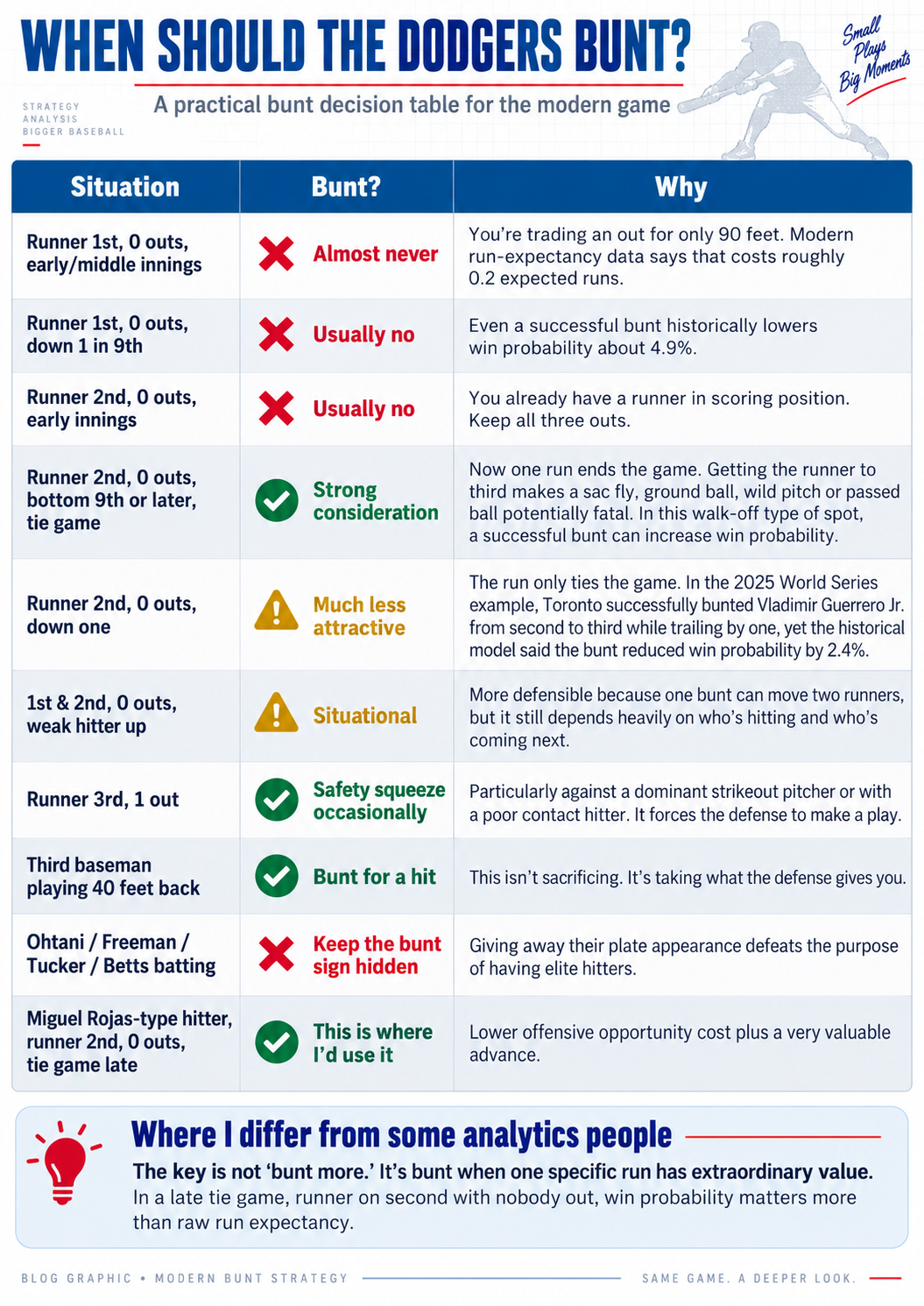
Here's where I differ from some analytics people
Run expectancy isn't always the right measurement.
Suppose it's the bottom of the ninth, 2-2, runner on second, nobody out.
I don't give a hoot whether the Dodgers' expected runs for the inning fall from 1.1 to 0.95.
I don't need 1.1 runs. I need ONE.
That's where win probability should override run expectancy.
Move that runner to third and suddenly the opposing pitcher is walking through a minefield:
Sac fly. Ground ball through a drawn-in infield. Wild pitch. Passed ball. Balk. Bunt. Infield hit. Error.
The defense also has to change. With the winning run on third, the infield may come in, dramatically increasing the chance that an ordinary ground ball becomes a hit.
And there's another bunt that I think is badly underused
The bunt for a hit.
Modern defenses are built around Statcast positioning. Third basemen frequently play deep because everyone's terrified of exit velocity.
Fine.
Drop one 25 feet down the third-base line.
Then do it again next week.
Suddenly that third baseman can't camp 105 feet from home plate. You've altered his positioning even when you don't bunt.
That's chess rather than sacrifice.
And MLB clubs themselves seem to be rediscovering this. Bunting increased noticeably in 2026 after years of decline.
The Dodgers situation I'd especially like to see
Tie game. Bottom 8th or later. Runner on second. Nobody out. Bottom third of the order.
Put the bunt on.
But with Ohtani, Betts, Freeman or Tucker?
Let them hit.
That's the middle ground I think modern baseball sometimes misses: analytics proved that routine sacrifice bunting was dumb. Somewhere along the way, some teams interpreted that as "bunting is dumb." Those aren't the same thing.
And there's an even more interesting Dodgers question: with their October history of striking out with runners in scoring position, is a Dodgers playoff bunt actually worth MORE than the generic MLB run-expectancy table says?
I can't say!
OKC Comets 12 – El Paso Chihuahuas (San Diego) 0
LHSP Jackson Ferris is ending the year with a flourish. Today, he took a perfect game into the 7th. It ended when Miguel Andujar reached on a 1-out infield single. Ferris retired the next two to end any threat.
Ferris walked his 1st batter with one out in the 8th. He struck out the next batter and reached 102 pitches. Ferris was relieved by LHRP Garrett McDaniels who got the final out.
RHRP Edwin Díaz was scheduled to pitch in this game. He entered the 9th in mop up duty. He got the first two outs, but then allowed a double to Andujar before getting the 3rd out on a 6-3 groundout. What does that mean for Díaz?
Ferris’ line – 7.2 IP, 0 runs, 1 hit, 1 BB, 13 K. Outstanding effort.
View post by @Bnicklaus7 on X
This was Ferris’ 6th consecutive excellent start. In those 6 starts, he had 36.0 IP, allowed 4 runs, 22 hits, 11 BB, and 48 K. That is a 1.00 ERA, 0.917 WHIP, and 12K/9, 2.75 BB/9, 4.36 K/BB. He has done this in 6 games in the PCL.
OKC did not put up much of an offense of their own over the first three innings. In the 4th inning, DH Ryan Ward and 1B Matt Gorski both singled. 2B Hyeseong Kim then lined into a triple play. Both runners took off on the pitch. Kim lined the pitch to 1B, who stepped on 1B, and threw to 2nd for the 3rd out.
View post by @MiLB on X
Ward’s single was probably his last AB with OKC. Hopefully someone will pick him up and keep him on their 40-man.
OKC broke through in the 5th. 3B Ryan Fitzgerald doubled (33), moved to 3rd on a WP, and scored on a SF from C Chadwick Tromp.
OKC broke it open in the 7th. Gorski led off with a double (4). Kim’s single scored Gorski. After Kim stole 2nd, he scored on Fitzgerald’s 2nd double of the game (34). Fitzgerald scored on SS Noah Miller’s RBI single. Miller stole 2nd and 3rd. Tromp drew a BB. CF Zach Ehrhard’s single scored Miller and Tromp moved to 2nd. LF Alek Thomas walked to load the bases. Miller scored on a SF from RF James Tibbs III. Pinch hitting for Ward, DH Chris Newell singled to score Tromp for 6 runs in the inning.
If they opened it up in the 7th, they slammed the door shut in the 8th. Fitzgerald opened with a BB and Miller followed with a single. With one out, Ehrhard walked to load the bases. Thomas singled to score Fitzgerald. JTIII hit his 2nd SF of the game. Newell then put on the exclamation point with a 3-run HR and a 12-0 lead.
The win put OKC into the playoffs where they will play the Las Vegas Aviators (A’s) in a best 2 of three series that begins next Tuesday in Las Vegas at 7:05 PM PT. All games will be played in Las Vegas.
OKC still has 4 games to play to end the regular season. All four will be played in El Paso.
· Alek Thomas – 2-4, 1 BB, 1 run, 1 RBI
· Chris Newell – 2-3, 1 run, 4 RBI, HR (3)
· Matt Gorski – 2-5, 1 run, double (4)
· Ryan Fitzgerald – 2-4, 1 BB, 3 runs, 1 RBI, 2 doubles (34)
· Noah Miller – 2-5, 2 runs, 1 RBI
· Zach Ehrhard – 1-3, 2 BB, 2 runs, 1 RBI
Great Lakes News
View post by @greatlakesloons on X
View post by @greatlakesloons on X
View post by @BaseballAmerica on X
View post by @msalas24 on X
Discussion (2)
Disagree, not disagreeable
Things aren’t exactly looking up. Bunting won’t help.
No