
Player Profile: Frank Howard
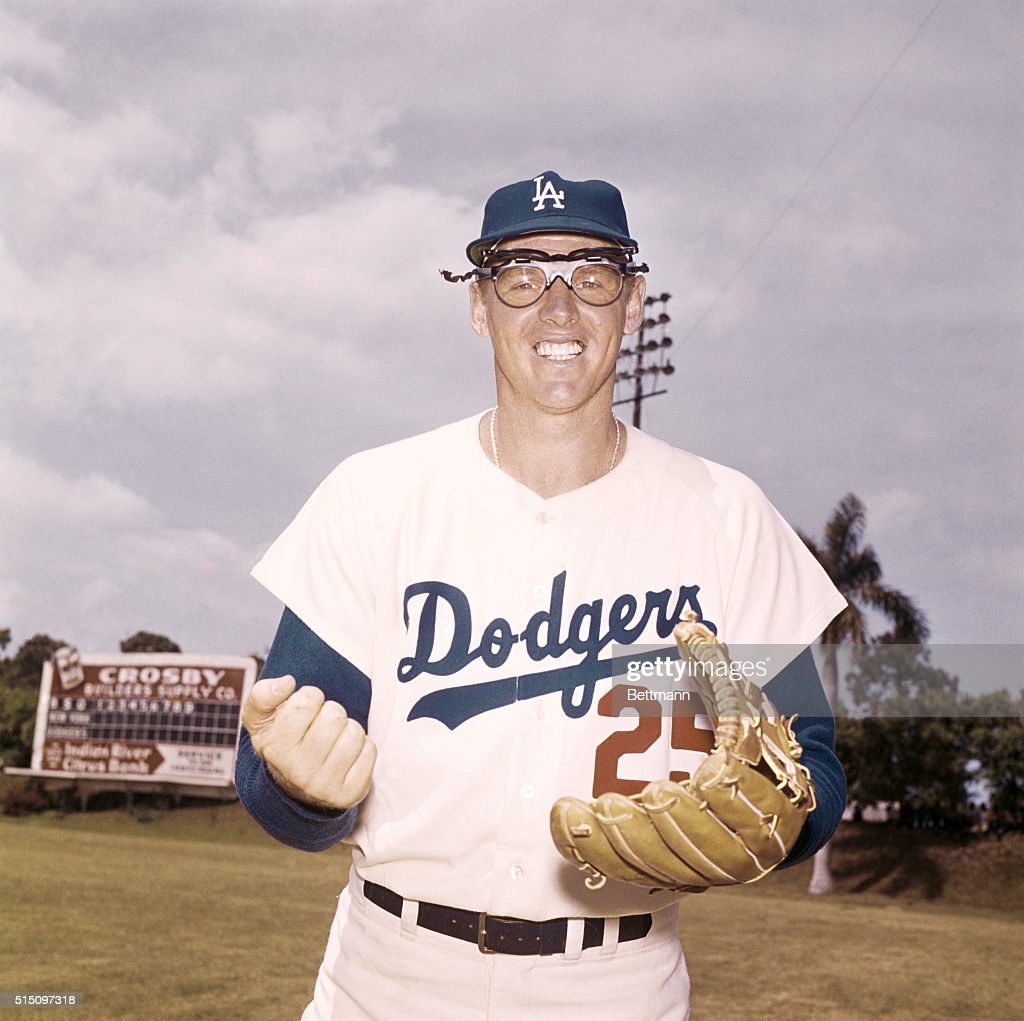
Vero Beach, Fla.: Frank Howard of the Dodgers is shown in this closeup wearing glasses and smiling. Frank Oliver Howard was born on August 8, 1936 in Columbus, Ohio to John and Erma Howard. His dad was a large man, 6’4″ over 200 pounds. He worked as a machinist for the…

Frank Oliver Howard was born on August 8, 1936 in Columbus, Ohio to John and Erma Howard. His dad was a large man, 6’4″ over 200 pounds. He worked as a machinist for the Chesapeake and Ohio Railroad in Columbus. His mother was a homemaker. Frank was the third of six children. The family lived in a modest frame house. “There was always lots of food on the table” Howard remembered, “but if we kids wanted money, we had to go out and earn it”. Frank shined shoes, caddied, and did the hard manual labor befitting his size. ” When I was 14:, he recalled, ” I worked a 100-pound jackhammer in the streets for the city of Columbus, got paid maybe a dollar and a half an hour, and was glad to get it.” By the middle of his tenure at South High School, he had grown to 6’5″, 195 pounds.
John Howard had played semi-pro baseball around Columbus and he encouraged Frank’s interest in the game. He had no desire to play football but played both basketball, at which he excelled, and baseball, his game of choice. Howard was good enough to be widely recruited to play college basketball, but he decided to stay home and attend Ohio State. His coach there, Floyd Stahl, recalled that Frank was anxious to get an education. But he had almost no money. They did not have the grants-in-aid they have today or the sports scholarships. He told Howard he thought they could get some jobs for him around the school. He did get a little aid from the school, but he worked at odd jobs for four years. When Stahl got him a job working on a cement crew, the foreman told him “Howard does twice as much work as any laborer I’ve had”. Stahl was now worried that he would work too hard and overtrain.
But Howard became a star for the Buckeyes, earning All-American honors as a junior, and setting a Madison Square Garden record in a holiday tournament with 32 rebounds for a game, and 75 for the three games. The next year Howard was drafted by the Philadelphia Warriors of the NBA. He also played baseball for OSU, eclipsing the .300 mark in two seasons and displaying occasional glimpses of the power for which he would become known. The Dodgers were scouting him in 1957. Scout Cliff Alexander noted he was a definite follow. He almost signed that summer but he had promised Stahl he would return for his senior year to play basketball.
After his senior year was over, he let the scouts know he was ready to sign. He had a lot of offers, but the Dodgers had been talking to him for a couple of years and he never really considered any other teams. Alexander remembers that Howard called him up and told him that Paul Richards, who was running the Orioles at the time, had offered him a $120,000 bonus. Howard asked Alexander for $108,000. 100K for himself and 8K to go to a new house for his parents. Alexander agreed and Howard was on his way. He left Ohio State one semester short of a degree in physical education.
Howard was sent to the teams Green Bay team in the Class-B Three-I League. His manager there was Pete Reiser. He had no problem there hitting .333 with 37 long balls and 119 driven in. He was the league’s MVP. One evening at a local pizza parlor, he met Carol Johanski, a secretary for the Green Bay Gazette. Six months later they were married and Howard bought a house in Green Bay and settled there.
In September, Howard was called up to the big club. He made his debut on Sept 10th at Connie Mack Stadium. Hitting against Robin Roberts he went 2-4 including a mammoth homer in his second big league at-bat. The drive hit the billboard atop the left-field roof, causing the left fielder, Harry Anderson to say he was afraid the billboard was going to fall on his head. On the 16th of the month in Cincinnati, he came to bat with teammate, Duke Snider on third. Scully commented about Snider being way off the foul line due to Howard’s penchant for hitting vicious line drives in that direction. Just as Scully said this, Howard hit a vicious line drive that caught Snider square in the head, knocking him unconscious briefly and ending the Duke’s season. Howard finished with a .241 avg in 29 at-bats.
In 59, the Dodgers sent Howard to Victoria in the Texas League. Howard was on his way to a triple crown with a .371 avg, 27 homers, and 71 RBIs. Buzzie Bavasi came and watched the team. When he saw Howard hit a 520 Ft. homer to win a game, he took him back to L.A. with him. He was only with the team a week, going 2-19, and then was sent to AAA Spokane. He hit .316 with Spokane with 16 more long balls. He was called back to the Dodgers in September. With the team in the middle of a pennant race, he only got 2 at-bats. One of them was a PH homer off of Lindy McDaniel on the 23rd. The Dodgers ended up winning the pennant and World Series. After the season Howard was named the Minor League Player of the Year by The Sporting News.
By the spring of 1960, stories about Howard’s prodigious homers and his vicious line drives threatening the lives of runners on base were already being repeatedly told around the league. In a time when many players were not even six feet tall, and when the biggest stars in the National League, Mays, Aaron, Banks and Robinson, were all around 180 pounds, Howard had reached almost 6’8″ and 250 pounds. He was heavier at times in his career. His teammate, Jr. Gilliam, all 5’10” of him spoke for many when he said,“a man that big should hit 50 homers every year, and I mean every year”. He was still a work in progress. Playing first base and the outfield, usually right. His strike zone was huge and he still swung at too many bad pitches. Until he finds himself, LA is just going to have to settle for a mere mortal.
He still had the task in the spring of 1960 to make the roster of a Championship team. He did ok in spring, hitting .268 with a couple of homers. But then he had a run-in with Walter Alston over his playing time. So he was sent back to Spokane to start the year. He wasn’t there long, hitting .371 in 26 games. He returned to the Dodgers and had a .268 BA with 23 homers. After the season he was named the Rookie of the Year. He was the team’s 5th recipient of the award.
His 61-season started off slow with a chipped bone in his thumb. Alston had intended to move him to first base, but the injury and his recovery took time. He ended up hitting .296 with 15 HRs in just 267 at-bats. He started in only 72 games, usually in RF. He was increasingly frustrated with his inability to stay on the field. After the 61 season, the Dodgers lost both of their first basemen, Hodges and Larker, to the expansion draft.
Alston moved Ron Fairly to first to give Howard more playing time. Playing in only 123 games he hit .296 with 31 HRs and 119 RBIs. He still was undisciplined and struck out 108 times with only 39 walks. The Dodgers were a good offensive team and won 102 games in their new home, Dodger Stadium, only to fall to the Giants in a playoff.
In 1963 Howard began wearing glasses. He immediately hit 3 homers in four games. He was hot in April, but a slump in May and June cost him his starting job. He alternated with Wally Moon the rest of the year. He still managed a .273 BA with 28 HRs, by far the most on the team. He also set a Dodger record for K’s with 116. Since obliterated by a couple of current Dodgers.
In the first game of the World Series, he hit a ball 460 feet to left-center off of Whitey Ford for the longest double in the 41-year history of Yankee Stadium. Landing near the monuments which were in the field of play in that era. Then in game 4, he hit a 450 HR into the loge section at Dodger Stadium, again off of Ford. Frank went 3-10 in three games.
After the 63 season, Howard, who had been compared to Ruth was pretty realistic. He said, I can never be a great ballplayer, because great players do five things well, fun, field, throw, hit, and hit with power. I am mediocre at four of those, but I can hit with power. So, he went in to talk to Bavasi to find out where he stood with the team. Over his time with the Dodgers he had appeared in about 2/3rds of their games. He averaged 24 homers a year. Both Bavasi and Alston said they believed in him. But he got off to a slow start in 64, and eventually, Alston began platooning him again. He ended up with a .229 avg and 24 homers in 433 at-bats. Both Alston and Bavasi had come to the conclusion that they could not win with power and they needed pitching and defense and speed to win in Dodger Stadium. In the off-season, Frank asked the Dodgers to trade him and they obliged.
On Dec 4th, he was sent to the Senators along with Ken McMullen, Phil Ortega and Pete Richert for Claude Osteen, John Kennedy, and $100,000 in cash. Asked if he was disappointed going to DC, Frank said” Oh no, I knew it was time. I am at the stage of my life where I need to find out if I can play everyday”.
His manager in DC was former teammate Gil Hodges. Howard remained his own biggest critic. He knew he was not a great fielder, but he worked very hard trying to improve. Howard is being paid to hit, was a quote from Hodges. Frank, playing mostly LF for the Senators, battled injuries and finished with a .289/21/84 line to lead the team in all those categories. He had a similar year in 66 with a .278/18/71 in 146 games. Looking back on his record from those days, you have to remember how depressed run-scoring was in the 60s. Although Howard was not a star, his OPS of .790 compared favorably to the AL’s .670. He also continued to make news and add to his legend, with his long home runs. In one of those games, in DC against the White Sox in April, Tommy John threw him a ball that he hit right back at him with John falling-off of the mound trying to get out of the way, CF, Tommy Agee, came in like he was going to catch a line drive and the ball took off like it was a shot from a 2-iron and ended up in the upper deck in center field. They painted another seat. The Senators began painting seats where Howards’ homers had landed.
Before the 1967 season, Hodges worked with Howard to retool his swing. He asked him to use a slight uppercut instead of a level swing and to move closer to the plate so he could pull the ball. The result was a 36 HR season, he had 24 by mid-season, Even though he led the league in K’s with 155, his OPS was .849, eighth in the league. Hodges moved on to the Mets in 68. In the year of the pitcher, when the AL hit .230 and had shutouts in 20 percent of its games, Howard to a step forward and became the hitter people predicted he would be a decade earlier.
He hit .338 in April, but his best stretch came in May when he collected 10 HRs and 17 RBIs in a six-game span. He set records for the most homers in four games(7), five games (8), and six games (10). Joe Sparma, who gave up HR #8, said” He is always good for 30 homers anyway, this year he is hitting my best stuff, he will probably hit 70″. As usual, Howard was less impressed than the press. ” I am just trying to have 3 good at-bats a game”. He said.
Howard settled down for a final .274/44/106 line. He played in his first all-star game going 0-2 in the AL’s loss. He gave a lot of credit for his success to his manager, Jim Lemon. Lemon also used him at first base 51 times that year. At 32 it seemed Howard had finally figured it out.
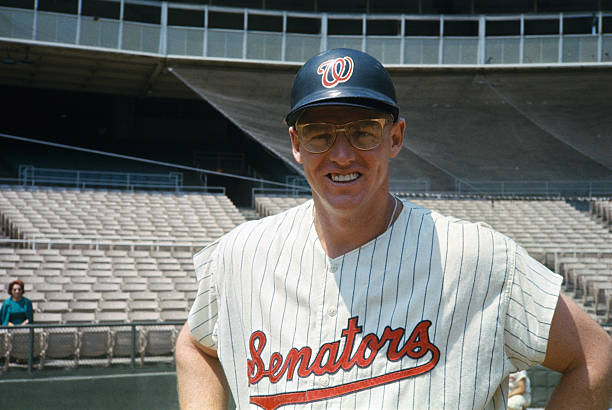
Howard, who had been nicknamed “Hondo” early in his career picked up a couple more in DC, “Washington Monument” and “The Capital Punisher“. After the 10th place finish in 1968, new owner Bob Short took over in January and fired Lemon. He then lured Hall of Famer, Ted Williams, out of retirement, surprising everyone around the game. For Howard, it would be another turning point, perhaps the most important one. Williams thought he knew how to make Howard a better hitter.
Williams called him into his office one day in the spring, he said, “Bush, come on in here“. “I’d only been in camp a couple of days and I am thinking, I’m not in his doghouse already am I”? “Can you tell me how a guy who hit 44 HRs only got 48 walks?” Howard explained and then Williams got to the point. “Well let me ask you, can you take a strike? I’m, talking about if it’s a tough fastball in a tough zone, first pitch. Or if it’s a breaking ball and you are sitting on a fastball… Can you take a strike? Try to get yourself a little better count to hit in”? Howard said he could. “Well try it for me”.
Howard increased his walks from 54 to 102. He decreased his K’s from 141 to 96. He hit 48 HRs and drove in 111 while hitting .296. He led the league with 330 total bases and was among the leaders in slugging, .574, and OBP, .402. He hit a homer off of Steve Carlton in the All-Star game which was held at his home park in DC.
He hit 44 HR’s the next year with 126 RBIs and led the league in walks, 132. Coming off of his three best seasons, the 35-year-old Howard tailed off in 71. His drop-off might have had something to do with the fact that he reported to camp at a whopping 297 pounds. He worked very hard to get the weight off. It might have affected him at the start of the season, but the big story in DC was the protracted effort to find a local buyer for the team. It was resolved late in the season when Short was given permission to move the team to Arlington Texas. Howard hit the last homer by a Senator in DC, but the game was ultimately forfeited to the Yankees when angry fans stormed the field. Baseball would not return to DC for 34 years.
Howard was one of the highest paid players in the game, reaching $125,000 in 1970. He held out for a small raise in 72 but then settled, by keeping his salary at $120,000. He still lived in Green Bay where he owned several shopping centers. He eventually reported to the team, and after a brief players’ strike that spring. On April 27, Howard appropriately hit a home run in his first at bat as a Ranger, the first homer in Arlington Stadium. It was a long blast to center field.
Howard was not the same hitter though. On August 31 he was sold to the Tigers. He joined a team fighting for a division title. He had one really good day when he went 3-4 and hit a homer off of the O’s, Dave McNally. The Tigers won by 1/2 game. Because he joined the team on September first, he was ineligible for post-season play.
In 1973, the DH was brought into the AL. It was made for a guy like Howard. In 85 games he hit .256 and slugged 12 homers. In October, he was released, and his MLB career was over. He signed for the 1974 season to play with the Lions of the Japanese Pacific League. He hurt his back in his first at bat and never played again. He was 37 years old.
After his playing days were over, Howard had a long career in MLB, mostly as a coach. He also was interim manager a couple of times, with the Brewers and then with the Mets. Most of his employers thought he was too nice to be successful as a manager. Besides those two teams, he served as a coach for the Mariners, Yankees, and the Rays.
He relocated from Green Bay to Northern Virginia. He and his wife raised six kids, but their marriage ended in 1991. Howard remarried. He and his wife were still married as of 2012. When the Expos moved to DC in 2005, Howard became the link between the old team and the new. Especially when they began playing in RFK stadium, where Howard had played.
When they moved to the new stadium in 2008, they unveiled three statues. Walter Johnson, their HOF pitcher from the early days, Josh Gibson, a star in the Negro Leagues for the Homestead Grays who played in old Griffith Stadium, and Frank Howard, who represented the expansion, Senators. Howard may not have reached the heights many predicted for him, and he was his own biggest critic. But he had some good years, and now he has a statue at a ballpark. Not many players have one of those. Yep, the pitcher’s worst nightmare. The Capital Punisher indeed.
More from Dodger Talk

Enjoy it While You Can!
It was both surprising and not surprising to me that the Dodgers signed Kyle Tucker. That they can make it work is a tribute to the true genius of Mark Walter and Andrew Friedman. Enjoy it while you can, because it will end soon. In the upcoming CBA and talks among owners, MLB…

Dodgers Food Trailer
I did this interview a couple of weeks ago with Chef Mike, who runs the Dodgers Food Trailer for the Great Lakes Loons. They are there for every home and road regular season and playoff game. They prepare three meals a day for approximately 50 people (players and coaches). Since games end late most evenings, they do not prepare breakfast. Many of their hotels have a complimentary breakfast anyway. However,…

Meet LAD 2026 Draft Picks 1-12
3 picks were High School players (2 SS and 1 OF). There was a college OF, college catcher, college SS, and 10 college pitchers. Of all the talk for a need for a catcher, the only catcher the Dodgers selected was Luke Bard, son of LAD bullpen coach Josh Bard. Bard was a 4th year senior from Houston Christian University. He is not a prospect, so the Dodgers are still…

Interview with Paul Beachy – Team Bus Driver For The Great Lakes Loons (LA Dodgers Minor League Team)
It’s been a few days since I did this interview. We have evidently been working my son-in-law (the video guy) like a rented mule at US Water Systems. However, I am taking him to London with me in a few days, so maybe Watford will buy him a pint as a tip, but he’s a dang Red Sox fan, so there is that! I thought that it would be interesting…
Discussion (63)
Disagree, not disagreeable
Wow Bear, great write-up on Frank Howard. I didn’t realize how huge that dude was! I love that he worked a jackhammer as a teenager. Must of made his arms jacked!
Bobby, thanks for the awesome pics! I love going to Opening Day games. What a treat having those F-35s fly over.
The Dodgers are going to make me expect a huge inning every game the way things are going.
Well, that didn’t take long. We’re in 1st place and Belli is one of the best hitters on the team. Right behind Lux and Taylor. Lucky TM isn’t the GM, Lux and Belli would be gone!
Just curious, Kershaw who pitched more than anyone this Spring gets pulled after 80, but they leave Bueller in for 98 with all those guys in the pen? Why?
It was very nice of Fraley to help out turning Will Smith’s double into a homer.
It was awesome seeing Freddie get that standing ovation to go with a couple of knocks and his family and friends fill up that suite. Freddie belongs here. Thanks Seags, for making this possible. BTW – How do you like last place? Was the money worth it?
Well, they finally moved Muncy out of the cleanup spot. When are they going to swap Trea and Freddie and put them where they belong?
Lux was too hot, had to sit him yesterday. Probably rest Belli today?
Still pissed about the Apple+. I took the day off today for Good Friday, so it’s indeed a good Friday. Last Friday of lent, no meat, so I won’t be going to In N Out today. Maybe I’ll sign up and install Apple+ on all my TV’s, Roku, Firesticks today.
I was thinking about passing on the game tonight, but I can’t resist watching on Jackie day. Possibly the best person to ever play the game and another big reason to be a proud Dodgers fan.
42!