
My First Favorite Player Was a Yankee
At a very early age, I loved to read. When I began to love the game of baseball, I read every book in the school library I possibly could on the subject. Some were novels about the game like John R. Tunis’s series about the Brooklyn Dodgers. Others were biography’s written…

At a very early age, I loved to read. When I began to love the game of baseball, I read every book in the school library I possibly could on the subject. Some were novels about the game like John R. Tunis’s series about the Brooklyn Dodgers. Others were biography’s written specifically for young kids. One of the first I read was about Lou Gehrig.
No, I never got to see him play except in old grainy videos they would show of the 27 Yankees or Lou taking BP. Lou was so much different than Ruth, who in many ways was larger than life. Babe lived each day to the fullest. His excesses were legendary. Gehrig was quiet and went about his business without all the fanfare. Until 1935, he played in Ruth’s larger than life shadow. From 35-38, the Yankees were his team. Then fate stepped in. From 39 on, it was Joe DiMaggio’s team. Lou would be forced to retire because of an illness.
2130 consecutive games played. Lou played with broken fingers, and almost any ache and pain you can think of. He never took a day off until he walked into the manager’s office and told him to put someone else in. Oddly, his replacement that day in the lineup was a guy nicknamed Babe. Babe Dahlgren.
Gehrig was born Henrich Ludwig Gehrig to Anna Chritina and Henrich Willhelm Gehrig, German immigrants, on June 19, 1903, in East Harlem, New York. He weighed almost 14 pounds at birth. He was the second of four children. His father was a sheet metal worker but was frequently unemployed due to epilepsy and alcoholism. His mother was the main breadwinner and worked as a maid. His mother came to the US in 1899, and his father in 1888. His mother was 14 years younger than his dad. They married in 1900.
Lou was the only child to live to adulthood. Both of his sisters died young of whooping cough, and his brother died in infancy. Gehrig did not learn to speak English until he was five. From a very early age he helped his mother work doing tasks like folding clothes and picking up supplies from local stores. He was called Lou so he would not be confused with his father.
Lou went to Commerce High School, graduating in 1921. He first gained national attention for baseball when playing a game at Wrigley Field in June of 1920. With his team leading in the 9th inning, 8-6, Gehrig hit a grand slam completely out of the park in front of 10,000 people. That was unheard of by a 17-year-old.
After graduating in January of 1921, Gehrig enrolled at Columbia University in New York in February on a football scholarship. College baseball at the time was not very organized and they played a brief schedule, so the chance of playing in front of scouts was slim. But Gehrig was well known because of his exploits in Chicago.
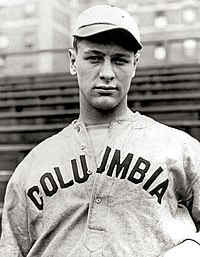
A scout for the Giants, Arthur Irwin, told him that John McGraw had seen him play, and would he be interested in a tryout. McGraw, he told him was interested in signing him to a contract. With his family as poor as it was, this was enticing so Lou agreed. In June of 21, he went to a tryout at the Polo Grounds. Contrary to what Irwin had told him, McGraw had never seen him play and certainly had never promised to sign him.
Six consecutive homers in batting practice though caught the attention of everyone on the field including McGraw. In the field though, it was not so good. Lou let the first grounder roll through his legs. “Get that fellow out of here! I have enough lousy players without another one showing up.” McGraw said to his coaches.
Lou went home crushed but not defeated. Irwin had not given up on him either. He got him a contract to play for Hartford of the Class-A Eastern League for the rest of the season. He played 12 games for them under the name of Lefty Gehrig and also Lou Lewis. The Columbia coach, Andy Coakley discovered that he had done this and endangered his collegiate career by being paid. He went to Columbia’s main rivals and asked them to give special dispensation for Gehrig’s innocent mistake. He was suspended for a year but not expelled.
When Lou finally took the field in 23, his sophomore season, he set the college baseball world on fire. In 19 games, he set a record for BA, .444, slugging pct., .937 and homers, 7. His power soon became legend. One of his teammates recalled years later a homer he hit at Cornell. “Corneel had a high fence in right, then a road, then a forest. Lou hit one into the forest.”
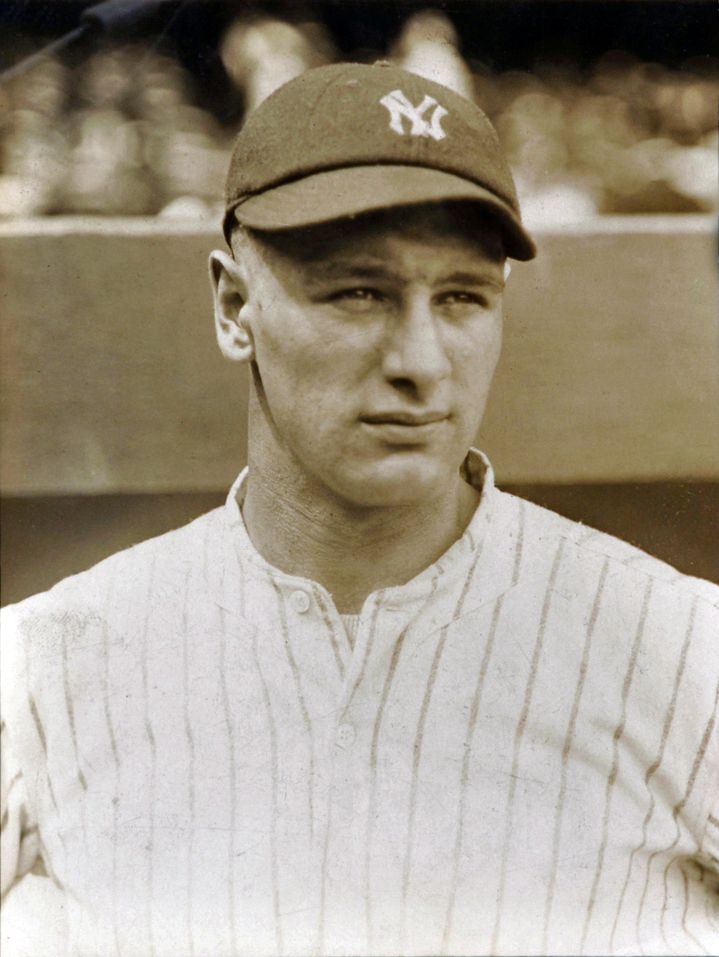
On April 26th, 1923, Yankee scout, Paul Krichell, attended a game between Rutgers and Columbia. Gehrig homered twice in three at bats. In their next game against NYU, Gehrig, who was also the team’s best pitcher, threw a complete game and went 2-3 with a prodigious homer. Krichell did not need to see anymore, he approached Gehrig and set up a meeting with Yankees GM, Ed Barrow for the next morning.
Barrow offered Gehrig a contract for 400 dollars a month with a 1,500-dollar bonus. Gehrig accepted and signed with the Yankees. This was a veritable fortune to the impoverished Gehrig’s. Lou was more than happy to be able to help his family and not terribly upset to leave a college that he had no real ties to.
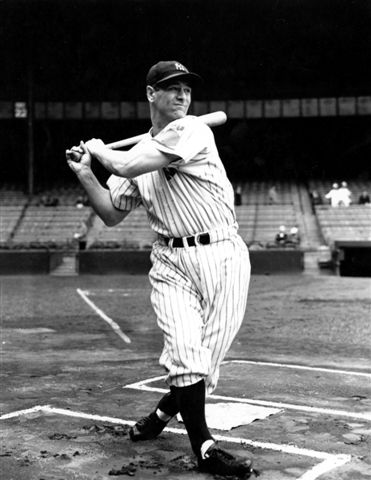
The Yankees had hoped that the young player was MLB ready. He played just 7 games with NY early in the year. Yanks skipper, Miller Huggins asked him to play in the minors, once again at Hartford.
In 59 games, Lou hit .304with 24 homers When the Senators season was over in September, Gehrig was recalled to the Yankees. He played in 6 games and had a homer and 8 driven in. Because of that, Huggins tried to have him added to the World Series roster, but the petition was turned down by commissioner Landis. John McGraw had complained. It did not matter, Yanks won 4-2.
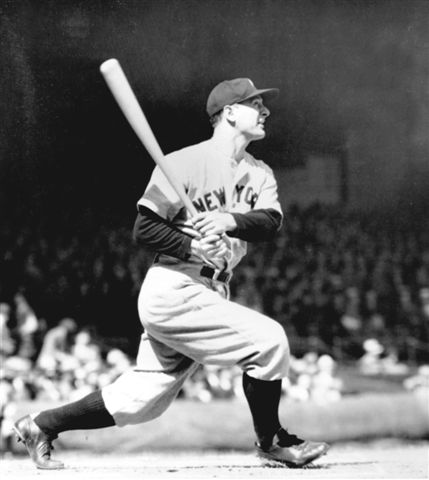
They sent him back to the minors in 24 to get more seasoning. He hit .369 with 37 homers, 40 doubles and 13 triples in 134 games. He came up for a short time and hit .500 with 5 RBIs in 12 at bats. The biggest thing that happened during that call up was a dust up with Ty Cobb. Gehrig hit a 2-run single to right and then rounded too far and got caught in a pickle. He extended the run down and Cobb sprinted in from center and tagged him out, cursing Gehrig as he did so.
Gehrig, who was a mostly dignified player, started cursing at Cobb as he walked off the field. He continued cursing from the Yankees dugout. The umpire warned Gehrig to calm down, but Lou kept yelling. After a second warning went unheeded, the umpire ejected Gehrig from the game. But he was still furious. When the game was over, Gehrig went after Cobb in the tunnel between the dugout and the clubhouse, despite Ruth’s best efforts, Gehrig got loose and took a swing at the meanest man in the game, he missed, slipped and landed on his head on the hard concrete floor, temporarily knocking himself out.
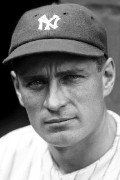
In 1925, Huggins decided that Gehrig was ready to play for the Yankees. But there was a small problem. The Yanks had a first baseman, Wally Pipp, who was coming off of his best season, .295/9/114 with 19 triples. Pipp was 32, so Gehrig filled in through April and May as a PH and back-up player. On June 2nd, during batting practice, Pipp was hit in the head on a pitch by Charlie Caldwell and would spend the next two weeks in a hospital. The wrong story was that Pipp complained of a headache and was removed before the game by Huggins. Being beaned in batting practice was what really happened. Actually, neither is true, Pipp did get beaned in batting practice and ended up with a concussion, but that happened on July 2nd, a full month after he was replaced. It was his and the team’s play which facilitated the move. He was hitting .244 when the change occurred. But the two different stories are more colorful than just being benched for mediocre play. The movie, “Pride of the Yankees with Gary Cooper, uses the headache story.
What happened next was baseball history. Gehrig would play the next 2,130 games straight. Pipp would finish the season with the Yankees, getting into 60 games and hitting just .230. In January of 26, the Yankees sold him to the Reds, who needed a first baseman after the untimely death of Jake Daubert, who once played for Brooklyn. He would play until 1928.
Lou had a strong rookie campaign, batting .295/20/68. He would not hit under .300 again until 1938, the onset of his illness when he hit .295/29/114. He hit .312 in 26 with 16 homers and 109 driven in. It would be the last time he hit less than 27 in a full season.
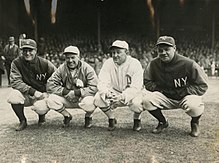
In 1927, Gehrig became what the Yankees thought he would become when he was signed. He led the league in doubles, 52, RBIs 173, and total bases 447. His slash line was .373/.474/.765 with an OPS of 1.240. Combined with Ruth’s MLB record 60, they hit 107 homers between them. No team in the American League had more than 55. Gehrig won the AL MVP award. But the rules were such that former MVPs were not eligible. Ruth had won in 1923 and arguably would have given Gehrig a good run, but he finished first over Harry Heilman of the Tigers. The Yanks swept the Pirates and got a 5,592-dollar bonus. Gehrig’s pay for the season had been 8,000.
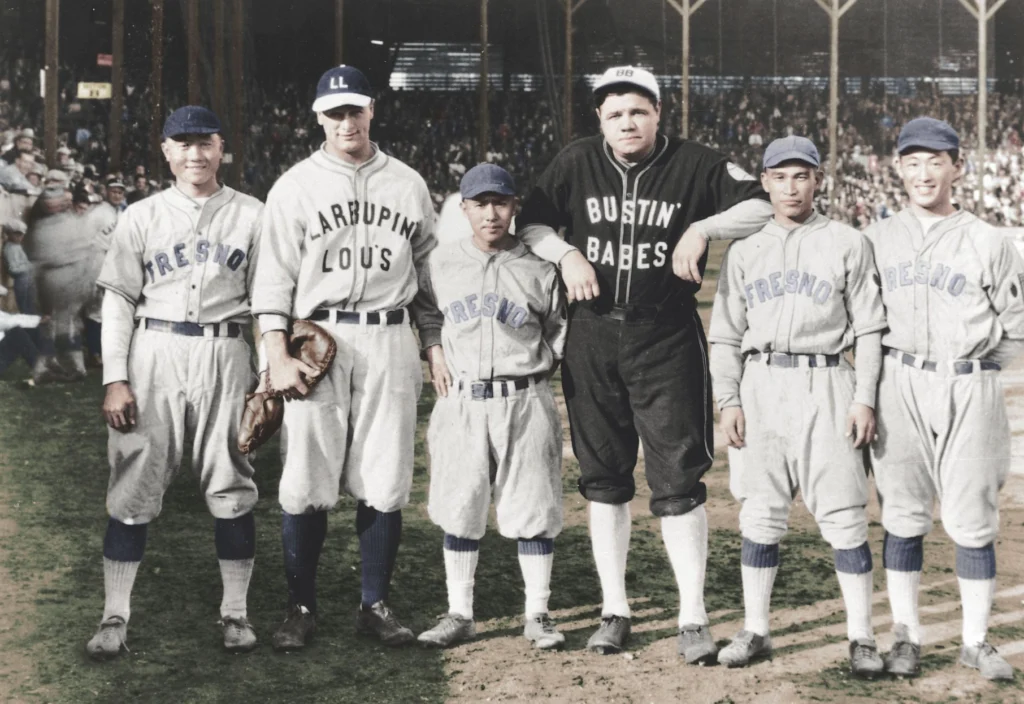
The two became friends and barnstormed together after the season. They would captain all-star teams made up of local players as the Bustin Babes and Larrupin Lous. They did this for three weeks. Babe made around 30,000 dollars and Lou around 10,000. Ruth told Lou to not settle for less than 30,000 on his next contract. The photo above is when Gehrig and Ruth toured Japan in 1934. One of the players on that tour, Mo Berg, was on a spying mission for the United States.
At first Lou did that. The contract the Yankees sent sat unsigned on his desk, Whatever the Yankees offered was never disclosed, but obviously it did not impress Gehrig. The impasse did not last long, Gehrig visited Ruppert at his brewery, and they reached an agreement on a 3-year-75,000-dollar deal.
The Yankees won again in 28 and played the Cardinals in the World Series. Lou had a great series hitting .545 with 4 homers, 2 of them in game 3 of the 4-game sweep. One of those was an inside the park homer. But he was still in Ruth’s shadow, Babe hit .625, highest average ever in a series to that point and hit 3 homers in the clincher.
1929 saw the rise of Connie Mack’s A’s. The A’s had a 10-game lead by June 25th, and the Yankees never caught them. They clinched on September 19th. The next day, Huggins checked himself into the hospital. He had been ill for some time. Turned out he had a rare skin infection called erysipelas, which had infected his bloodstream. Despite receiving four blood transfusions in less than a week, Huggins died on September 25th, 1929. He was 51 years old. His death crushed Gehrig.
In October, the stock market crashed sending the country into the great depression. The Yankees finished 3rd under new manager, Bob Shawkey in 1930. Gehrig had one of his best years batting .379/41/174. What makes those numbers amazing is that Gehrig played the last 3 weeks of the season with a broken finger that required surgery at the end of the season. The doctors also discovered bone chips in his elbow, which also required surgery. Despite that, he played in every game.
The Yankees did not rehire Shawkey and Joe McCarthy, who led the Cubs to the 1929 NL pennant was hired as manager. McCarthy was a strict manager, and he made it clear from day one that his players needed to be in shape or they would be benched. Gehrig always believed that. By the time McCarthy took over, he had already played in 888 straight games. The Yankees improved in 31, but the A’s won the pennant again. Gehrig hit .341/46/185, leading the AL in RBIs and tying Ruth for the homer title. He actually hit 47, but one of his homers was disallowed when the Yankee runner on base thought the ball had been caught and left the bases, Lou passed him erasing the homer.
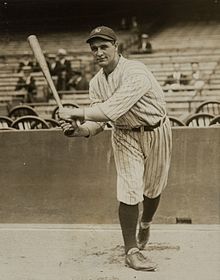
On could argue that Gehrig was as good as Ruth, but Babe was a better businessman. After his 3-year deal ended in 1930, Gehrig played the next two seasons on a pair of one year 25,000-dollar contracts. By comparison, Ruth made 80,000 each year.
With the country struggling and attendance dropping, Gehrig’s salary was cut to 23,000 for 32. The Yankees rebounded to win the pennant. Gehrig had perhaps his best game ever on June 3rd at Shibe Park against the A’s. Gehrig always liked hitting there. In his first three at bats, Gehrig took A’s righthander, George Earnshaw deep. To left center, and then right twice. Only two players had ever hit 4 in a game to that point, Ed Delahanty in 1896 and Bobby Lowe in 1894. He tied that with a homer off of reliever, Roy Mahaffey in his 4th at bat. He would get two more chances at #5. He grounded out in his 5th at bat, but in his sixth, he crushed a ball to center that Al Simmons leapt for and made a great catch. Gehrig said it was the hardest ball he hit all day.
Gehrig should have nabbed all the headlines that day, but John McGraw announced he was retiring from the Giants. The Times ran a front-page story on McGraw’s long career and accomplishments. The first man in the modern era to hit 4 homers in a game, let alone consecutively, was relegated to a to a short piece on the same sports page.
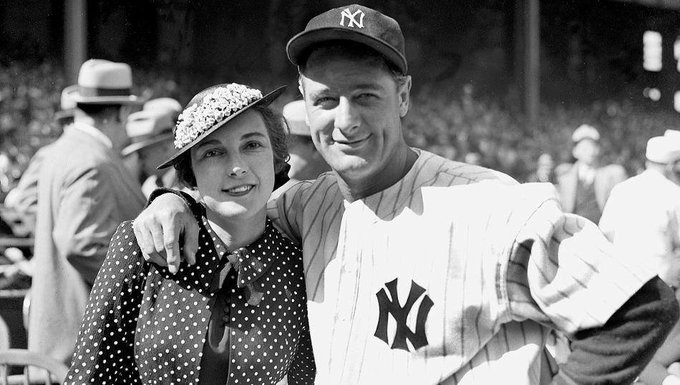
The Yankees would sweep the Cubs in the 32 series. Lou hit .529 with three homers, scored 9 runs and drove in 8. Despite that, he was overshadowed by Ruth again because of his so called, called shot off of Charlie Root in game 3. More important to his personal life, Lou met and began courting, Elenor Twitchell. They were polar opposites. Lou was reserved; Elenor was outgoing. She smoked, played poker and drank bathtub gin.
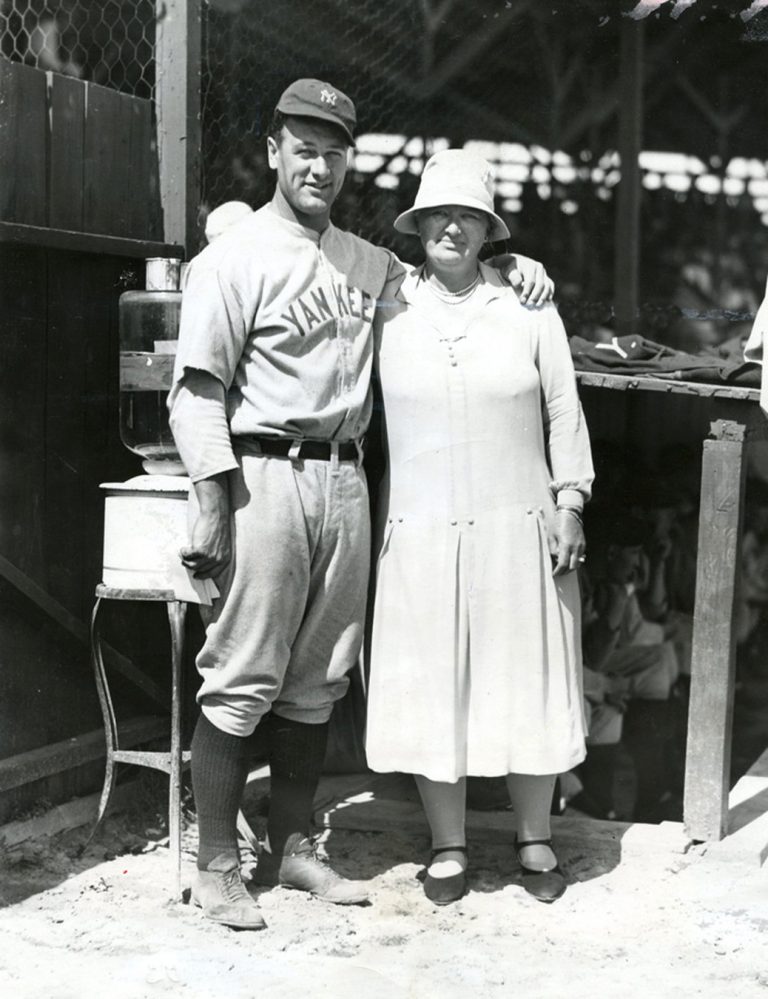
They would correspond and rarely spent any time alone, but they got along well, and Lou would visit whenever the Yankees came to Chicago to play the Sox. Lou’s mother did not approve, and Elenor accepted that. The couple was married on September 29th, 1933.
The Yankees finished 2nd three years in a row, 33-34-35. Lou had three very good years. He won the homer and RBI title in 1934, the second time in his career he had a WAR of 10 or higher. By 1934, Ruth was a shadow of himself, and he was sold to the Braves. The 35- Yankees were Gehrig’s team. McCarthy named him “team captain”.
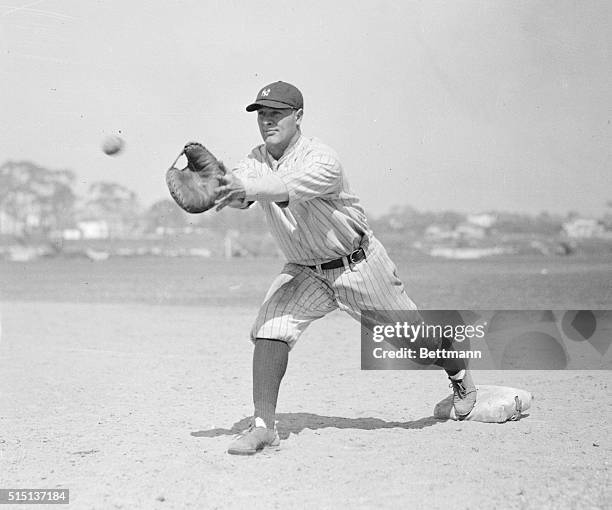
Early in 33, what should have been obvious to Gehrig, was brought to his attention by Dan Daniel. He asked Lou if he knew how many consecutive games, he had played in. Lou thought hundreds, Daniel informed him it was 1250, 57 short of the record set by former Yankees SS, “Deacon” Scott, from 1916-25 who had played in 1307 consecutive games. Thanks to the work of Daniel, writing about “the streak”, was picked up by sports writes all over the country. Lou broke the record on August 17th, 1933.
In 1936, Gehrig’s Yankees once again won the pennant. Gehrig hit .354 and led the league in homers with 49. He dove in 152 runs. The Yankees won the Series 4-2 over the crosstown Giants. Rookie Joe DiMaggio hit .349 for the series with 3 driven in. Lou hit .292 but had 2 homers and 7 RBI’s.
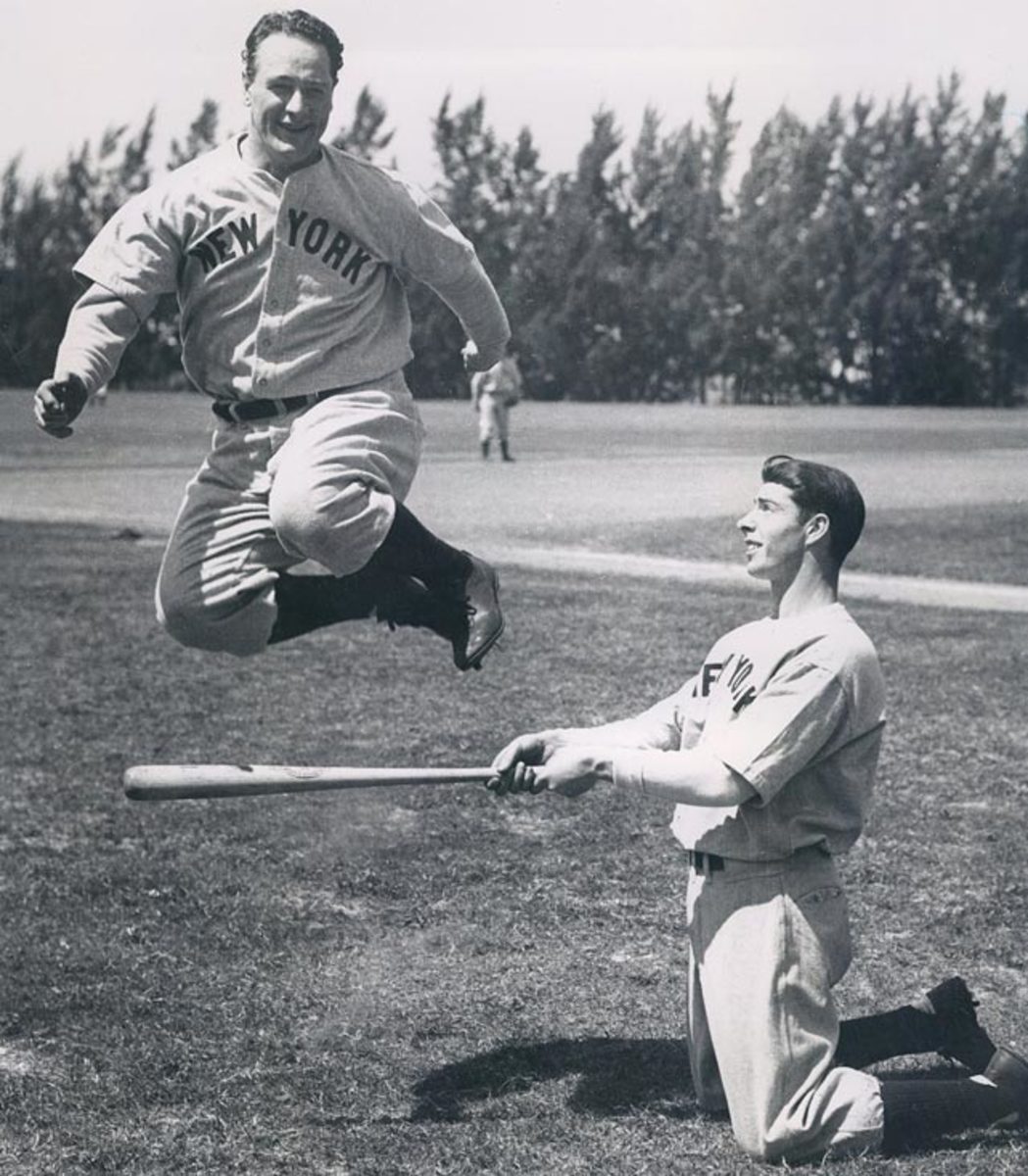
In 37, the 34-year-old Gehrig hit .351. He had 37 homers and 158 RBI’s. It was the sixth time in his career that Lou had hit higher than .350 and the 12th straight year he had hit above .300. It was the 7th time in his career that he had more than 150 RBI’s. The Yanks won the pennant and beat the Giants 4-1 in the series. Lou and DiMaggio each homered, but the hitting star was Tony Lazzeri
In 1938, Lou hit under .300 for the first time since his rookie season, .295. He had just 29 homers and drove in 114. The only thing he led the league in was games played with 157. They still had ties in those years, and the Yankees had 5. The 38 Yankees were DiMaggio’s team. The Yanks won the pennant and then swept the Cubs in the series.
On May 31st, 1938, Gehrig played in his 2000th consecutive game. As summer progressed, Gehrig began to break down. Somewhere along the way that summer, Elenor remarked that Lou had lost his power. A lumbago attack knocked him out of one game in the 5th inning. He jammed his finger catching a low throw from a pitcher. The Dr. wanted to x-ray his hand, but he refused saying, I’ll just shake it off.
But unlike years past when he played through the pain, he was not hitting. He had an extended drought through July and August and many were asking if the “Iron Horse” was in decline. McCarthy suggested he use a lighter bat, which he did, switching to a 33-ounce bat instead of the 38 he had used for years. He also changed the way he hit, and began to slap balls into gaps and such.
Some thought his decline was because of age, and the way he pushed himself. Others felt something else was at play. Gehrig’s salary was reduced for 1939 to 36,000 because of his down year. Lou told Barrow, the teams GM, that he would strive to return to form.
He exercised a lot that winter and often went ice skating with Elenor. Once when he inexplicitly fell while skating, she demanded he go see a doctor. The doctor diagnosed him with a gall bladder problem and put him on a bland diet.
It did not work; he continued to feel weak. By the time spring training ended, everyone knew something was wrong. The Yankees opened the season against the Red Sox. In his first at bat, Lou came to the plate with 2 men on base. Yankee fans rose cheering him on and hoping for a return to greatness. But he hit a soft fly to the Sox right fielder, a kid named Williams. It was the beginning of the end of one era, and the start of another. He played the next 7 games, hitting just .143 with just 1 RBI and no extra base hits. On May 2nd, he told McCarthy he should sit down for at least a few days. His streak ended at 2,130 consecutive games.
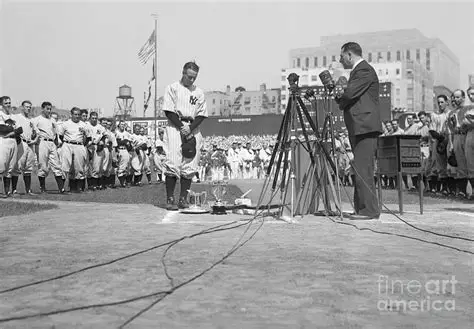
He continued to travel with the Yankees, but he did not play. He also continued to get weaker. Elenor finally contacted the famed Mayo Clinic in Rochester Minnesota. A team led by Dr. Mayo himself, reviewed Lou’s case. After six days of intensive testing, they found that he was suffering from amyotrophic lateral sclerosis, (ALS), a disease that caused the hardening of the spinal cord and would cause a slow painful deterioration of muscles and nerve endings. While the disease attacks the person’s body, it does not affect the mind, so the patient is totally aware during the last few days. In essence, it was a death sentence and Gehrig learned of that on his 36th birthday. They gave him 3-years max.
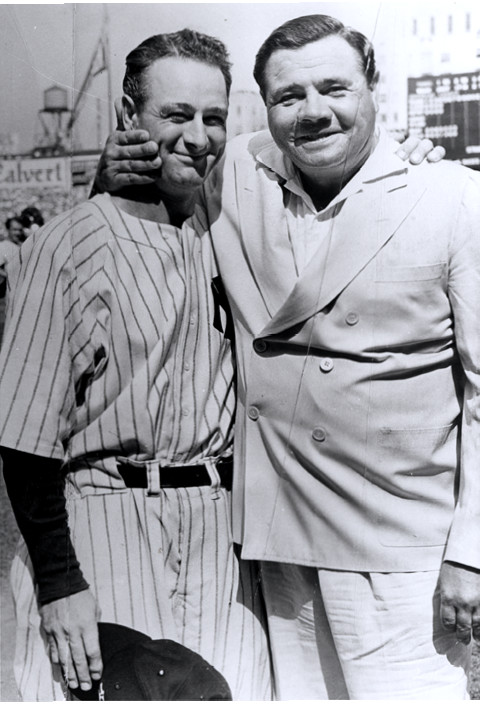
The Yankees announced that July 4th would be “Lou Gehrig Day”. They also announced his retirement. There were 42,000 fans in the stands that day. Members of the 27 Yankees team were there including Lazzeri, Combs, Meusel and Ruth. He received many gifts and Mayor LaGuardia spoke as did McCarthy and Ruth. Most of us have heard the speech. None will forget the last part of his opening line, “Today, I consider myself the luckiest man on the face of the earth.” Simple, to the point.
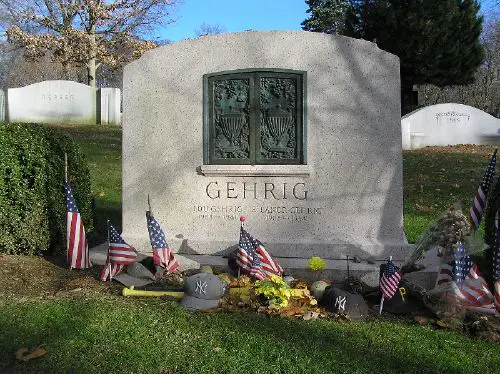
That was the reason Gehrig was my first baseball hero and favorite player. His courage in the face of certain death, his humble attitude, and the fact that he stood tall when the time came. Some call me old fashioned, but I truly admire courage and conviction. I also admire those who work so hard to achieve success in their chosen field. Gehrig was one of those people.
Gehrig’s final line: G: 2,164. AB’s: 8001 Hits: 2,721 HRs: 473, BA: .340 RBIs: 1995, OPS: 1.080, WAR: 113.7. In 34 World Series games, he hit .361/10/35. His OPS in those series was 1.214. In those series, the 26 series that they lost to the Cardinals was the only losing series he played in. In 34 games, the Yankees lost just 7.
More from Dodger Talk

Enjoy it While You Can!
It was both surprising and not surprising to me that the Dodgers signed Kyle Tucker. That they can make it work is a tribute to the true genius of Mark Walter and Andrew Friedman. Enjoy it while you can, because it will end soon. In the upcoming CBA and talks among owners, MLB…

Dodgers Food Trailer
I did this interview a couple of weeks ago with Chef Mike, who runs the Dodgers Food Trailer for the Great Lakes Loons. They are there for every home and road regular season and playoff game. They prepare three meals a day for approximately 50 people (players and coaches). Since games end late most evenings, they do not prepare breakfast. Many of their hotels have a complimentary breakfast anyway. However,…

Meet LAD 2026 Draft Picks 1-12
3 picks were High School players (2 SS and 1 OF). There was a college OF, college catcher, college SS, and 10 college pitchers. Of all the talk for a need for a catcher, the only catcher the Dodgers selected was Luke Bard, son of LAD bullpen coach Josh Bard. Bard was a 4th year senior from Houston Christian University. He is not a prospect, so the Dodgers are still…

Interview with Paul Beachy – Team Bus Driver For The Great Lakes Loons (LA Dodgers Minor League Team)
It’s been a few days since I did this interview. We have evidently been working my son-in-law (the video guy) like a rented mule at US Water Systems. However, I am taking him to London with me in a few days, so maybe Watford will buy him a pint as a tip, but he’s a dang Red Sox fan, so there is that! I thought that it would be interesting…
Discussion (48)
Disagree, not disagreeable
A Yankee? That’s heresy! String him up! 😉
If anyone got any emails from me do not open them. It’s spam. I was hacked.
Baseball first, Dodgers a very close second. A year ago we were wondering who would back up Smitty. Since that problem has been in resolved, I booked at thelcatching in the minors. It is actually pretty strong,cwirh the AAA and AA guys hitting well l.
Was “larrupin” ever a real word? Great report, Bear. We can only speculate what Gehrig’s career stats might have been. He also gave us that epic quote: “For the past two weeks you have been reading about a bad break. Yet today I consider myself the luckiest man on the face of the earth.”
Googled it…. The term “larrupin” means delicious or exceptionally good, often used to describe food that tastes particularly good, such as a “larrupin’ piece of barbecued beef.” .It can also be used as an intensifier, meaning “extremely” or “exceptionally” . The word has origins related to the verb “larrup,” which means to beat or strike, and it has been used in various forms since at least 1888. Anyway, Bear delivered a larrupin feature. .
I’ve told the story before so I’ll skip the deratals. . My first favorite player was Bob Cerv until I saw Mickey Mantle hit home runs from each side of the plate in Kansas City. I recall 7 home runs hit in that game but none like the ones Mantle hit. I was never a Yankees fan but in the over-the-line games we played until dark, I was Mickey Mantle, trying to hit them over everybody’s head from both sides of the plate. The older kids laughed, until I did it a couple of times. I of course read about the older players. I knew of the legends, but my guy was Mantle. The only player that was better was Mays. But he was a giant so screw him. I ran into him at Drysdale’s Hall of Fame Golf Tournament in Palm Springs. He was rude.
Duke was my guy from day 1 which was age 5. I was just me when playing over the line or home run derby. Mayby a lack of imagination. Mostly 2 on 2 or 3 on 3 so whomever was in the outfield would not want to move back a forth between lf and rf.
Cool down big boy. This was before the Dodgers moved to LA.
The AAA guys are not prospects. Robinson and Zavala are 32 and 33 respectively. Alonzo is 26. He turns 27 in September. Zavala and Robinson have both gotten some time in the majors. At AA, Lockwood-Powell is 28 and not really a prospect. Rodriguez and Quiroz have played in just 3 and 7 games. One other catcher on that roster is injured, Yeiner Fernandez.
Yes, it is, but it is larruping, they just dropped the g. You can type the word on your computer search and the definition comes up. You are right, that is the whole first line of his speech. He wore #4 when they started issuing numbers because he hit 4th in the order. That is why Ruth got 3.
Thanks. I larrup often.
Duke is and always will be my favorite Dodger. Met him at a card show, and my signed 8X10 of him hangs on my wall. Not a big collector of autographs. But there are a couple I wish I would have gotten. Gilliam was one. Koufax another. I do have Rick Mondays on a ball.
Tigers signed DeJong to a minor league deal. Roberts changed his mind and said Ohtani will NOT DH tonight. Sorry, but Wrobo got screwed. 4 wins, no losses and Ohtani with a 1-0 record gets pitcher of the month? Marlins DFAd Chris Paddack. Braves traded Jonah Heim to the A’s for cash. Padres assigned Alex Verdugo to the Arizona Complex League.
I respected both players for their greatness. Mays could have been a Dodger. When he was in the Negro League, Campy told the Dodgers they needed to send a scout to check the kid out. Mays was probably 17 at the time. Cannot remember the scout’s name, but he came back and told Rickey that the kid could not hit a curveball, so they passed. Not signing him and trying to hide Clemente at AAA when they had signed him to a bonus, two of their worst decisions.
Braves DFAd Carrasco and activated Iglesias.
Mays, Snider, and Clemente would have been nice.
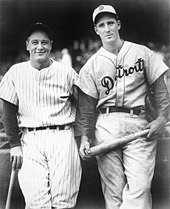
Great read Bear. I too consumed those biographies for kids about all the famous players. I was a Mantle fan as well as Willie Mays. One reason to be a Yankee’s fan in those days was the frequency they were on Saturday’s Game of the Week with Dizzy Dean and Pee Wee. It seemed like every Saturday the Yankees were on TV, back when there was one broadcast per week. I got familiar with the team. I can still clearly remember every player by position on those Yankee teams. I was 10 in 61, the year of the famous home run chase with Mickey and Maris, not rivaled to me until Sosa and McGwire in 1998. With the movies always taking journalistic liberty with the truth, it’s difficult to separate truth from fiction. I totally bought in to the story that Wally Pipp’s beaning was the reason for him losing his spot to Gehrig, which started his streak. Bear, you coached me up on the true story. I also heard and took as gospel, the story reflecting Gehrig’s streak, that Pipp, as an old man, was in the stands to see Gehrig’s streak end. The truth being Wally played 3 more seasons with the Reds, retiring at 35 in 1928. He would have been only 46 when Lou retired. He was not an old man than and lived for 25 more years. We believed a lot of false information back in those days. I loved the photo of Lou and a young DiMaggio and the fact that young Teddy Ballgame played against Gehrig in 39. And DiMaggio retiring in 51, Mantle’s rookie season. The baton passing from one legendary generation to the next. Great stuff, Bear.
Yes, probably would have been the best outfield in the majors. Duke would have moved to left, which Brooklyn had a lot of problems having a regular out there.
I agree with you. All three AAA catchers and GLP are organizational depth. Chuckie Robinson is probably the best defensive catcher of the group. He has had a good rep with working with pitchers and he has the most career success of the 4 guys for throwing out would be base stealers. Alfonzo is the youngest and is having a good offensive season thus far in a limited capacity: 74 PA, .311/.419/.426/.845, 4 doubles, 1 HR, 6 RBI, 12 BB and 5 K. Career Base Stealing stats (and 2026 stats) • Chuckie Robinson – 28.8% (1 out of 6 in 2026) • Seby Zavala – 25% (5 out of 26 in 2026) • Eliézer Alfonzo – 23.17% (2 out of 22 in 2026) • GLP – 15.8% (4 out of 34 in 2026) IMO, none of these are at the Hunter Feduccia or Ben Rortvedt tier. But I do not think AF/BG would hesitate bringing up any of the AAA catchers as a fill-in for an injury on a short term basis. Zavala has the most MLB experience, and has limited success. The organization does not have a clear catching prospect in MiLB. That will be a good research project for me.
Thanks Phil. Baseball biographical movies rarely get it right. There are a couple exceptions of course. William Bendix playing Ruth was a travesty. Most of that movie was pure bunk. When Reagan played Grover Cleveland Alexander in The Winning Team, most of that was fiction. He drank a lot, yes, but most of his problems came from him battling epilepsy. Dan Dailey as Dizzy Dean was pretty bad casting also. A very young Richard Crenna, from Rambo fame as Col Troutman, played Deans brother Paul. Problem is, very few of those guys had much athletic ability at all. None looked natural playing the game. In Babe’s story, when they filmed Babe hitting #60, all they needed was for Bendix to hit the ball in the air, so it would look like he crushed it. They tried for hours and he could not so much as hit a popup. The director, frustrated, said try it one more time. They did and according to legend, Bendix almost hit the ball into the stands. In “Pride of the Yankees”, Cooper was right-handed. He couldn’t do anything lefty, so they shot it and reversed the negative, He would run to third instead of first. Major League is more accurate since some of those guys, including Sheen, had played ball. Same with Bull Durham. At least in Field of Dreams, they just let Ray Liotta play Shoeless Joe right-handed. James Stewart played a ballplayer twice. Once in Strategic Air Command, where he plays a ballplayer recalled to the Air Force, and in The Stratton Story, about Monty Stratton, who lost a leg in a hunting accident and returned to pitch a few years in the minors.
The A’s are just inept. I have nothing against Jonah Heim, a quality catcher who can back up Langeliers very well. But they had Daniel Susac they paid $3.53MM to sign in 2022. They just let him go in the Rule 5 draft. They got nothing for him. Minnesota drafted him in Rule 5 draft and then traded him to SF.
A little extra about Stratton, in 1946, 8 years after the accident, he pitched for the Class-C Sherman Twins of the East Texas League. He went 18-8 with a 4.17 ERA. He pitched 218 innings basically on one leg. Quite a feat even in the minors.
That’s great Bear. You are so right about the lack of athleticism by actors like Bendix. Great story about his ineptitude. One of the reasons one of the only sports movies I liked was the Natural. Redford looked like he could play. Apparently he did at Van Nuys High, Drysdale’s high school. Richard Crenna was Luke McCoy as I’m sure you remember.
Roger.
Get to it Jefe! LOL.