
Dodgers vs Brewers - A Difference in Hitting Philosophy
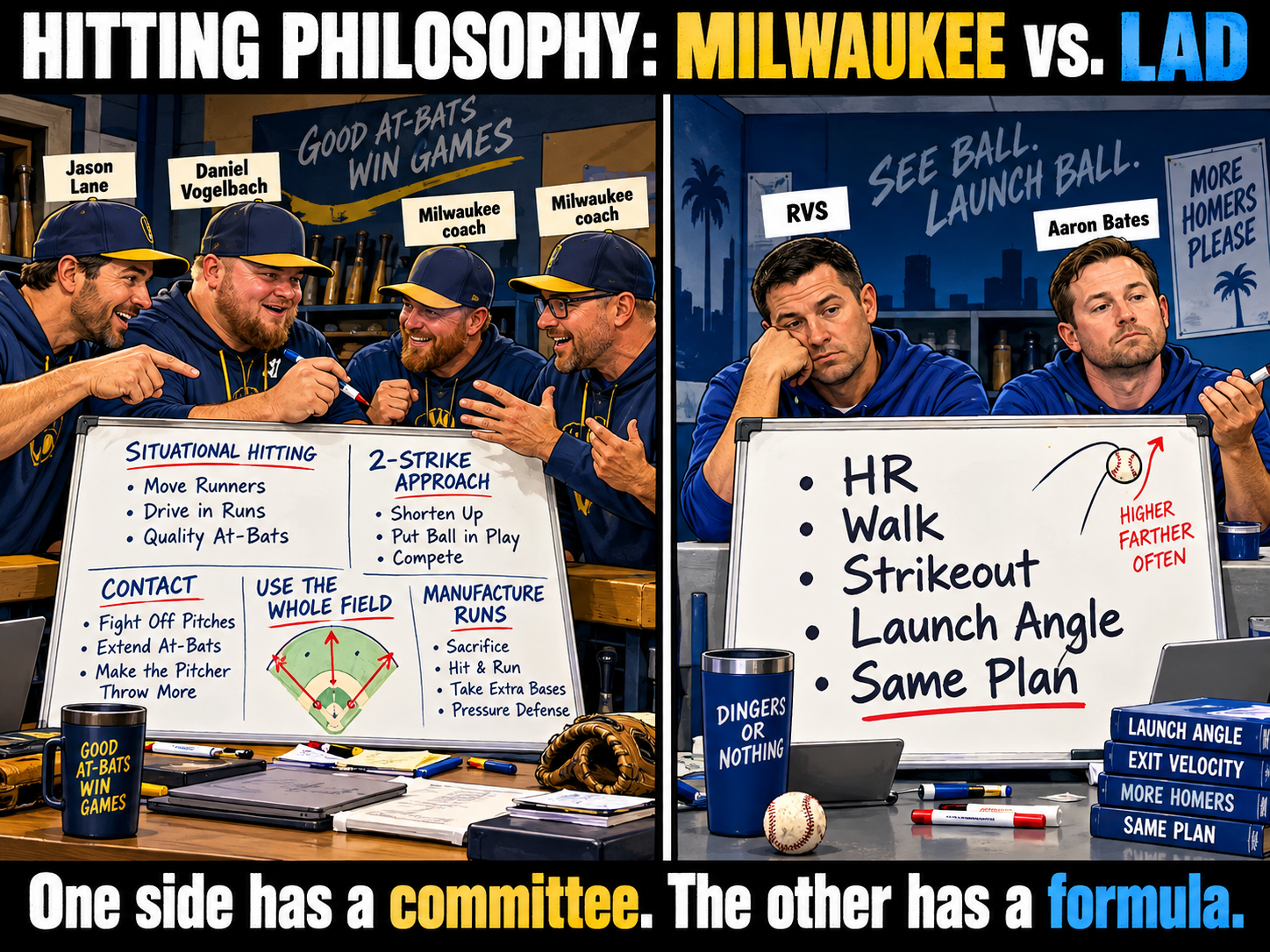
I have been very critical of RVS in the past and continue to be critical. But he is not going to be fired because he is coaching exactly what the front office and the computer nerds believe is the best way to win. RVS is the poster boy for launch angle pull side power. It has worked for the team, winning 3 WS. But like everything, change is inevitable. Weaknesses are exploited.
As Mark indicated, both Milwaukee and Tampa Bay emphasized the changes that they believed would help them win. More athleticism, contact, and speed. Neither team has the ability to pay for big established power hitters, so they adapted. It is a good thing for Tampa Bay that Junior Caminero has four more years of team control and 1 more year of pre-arbitration. They will not be able to keep him long-term, but they are not going to trade him before they have to.
I started doing some research on the different hitting philosophies of the Brewers and Dodgers. Brewers have gone away from a bench coach to 4 hitting coaches. The Brewers promoted former Brewers 3B Coach Jason Lane to offensive and strategy coordinator. Lane played for 7 years in MLB.
Defending a Strike with Accuracy: Lane teaches hitters that they don't necessarily need to swing max-effort or generate a home-run swing. Instead, the goal is to accurately match the bat to the ball's incoming flight path from the inside out. He notes that if a hitter squares a ball up perfectly, their natural power will automatically come out. (The Athletic)
Letting the Ball Travel Deep: A signature part of his strategy involves teaching hitters to see the ball a touch longer. Allowing the ball to travel deeper into the zone gives hitters a split-second more time to recognize modern, high-velocity fastballs and off-speed pitches. (The Athletic)
Attacking the Opposite Field: By letting the ball get deep, the goal is to drive pitches cleanly to the backside of the field. Lane emphasizes that there are fewer defenders on the back side of the field on lower-ball-flight plans. This philosophy is a major reason why the Brewers lean so heavily into opposite-field spray hitting to create traffic on the basepaths. (The Athletic and Press Democrat)
The Dual-Perspective Advantage: Lane's unique playing career significantly shapes his mental approach. He played in the Major Leagues as both an outfielder for the Houston Astros and later as a relief pitcher for the San Diego Padres. He uses this background to help hitters understand the specific "insecurities and fears" of the pitcher on the mound, allowing them to better game-plan their situational at-bats. (The Athletic and Press Democrat)
Milwaukee promoted Eric Theisen to lead hitting coach:
Player Ownership over Constant Correction: Theisen strongly believes that great hitters are not built through non-stop mechanical tweaking. His primary goal is to help hitters develop their own awareness so they can interpret sensory feedback from their swings and learn to self-regulate in real time. He strives to empower players to essentially "become their own best coaches".
Extreme Commitment to an Approach: To prevent hitters from getting trapped in "paralysis by analysis," Theisen preaches unwavering devotion to a specific situational plan. He teaches that true failure at the plate stems from being indecisive or rotating through different mental approaches during an at-bat. He actively encourages hitters to pick one comprehensive approach and be fully willing to stick with it through an entire 20-at-bat stretch, even if immediate results don't fall their way.
The third Brewers hitting coach is Guillermo Martinez, who had a 6-year MiLB career.
Martinez’s Philosophy: Stripping Down Data into "Pitch Hunting": Martinez believes that offensive collapse happens when hitters let the weight of the moment override their plan. Rather than overwhelming hitters with analytics, he strips the information down to basic decision-making in the batter's box. His hitters focus intensely on a binary choice: What pitch are you hunting, and what pitch are you willing to let go?
Milwaukee also hired former MLB hitter Daniel Vogelbach. Vogelbach is the more hands on coach who knows what it is like facing a MLB pitcher throwing 100 high and inside.
Vogelbach’s Philosophy: The Practical, Pitch-by-Pitch Mindset Approach.Vogelbach’s approach focuses heavily on simplifying the game, maintaining a strong baseball mindset, and establishing tactical plate discipline. Because he is only a couple of seasons removed from his 9-year MLB career, his teaching is tailored from the lens of a batter who has actively faced modern pitching. Perhaps more than any of the 4 coaches, Vogelbach has been the difference maker this year.
OTOH, the Dodgers have a two-man hitting crew: Robert Van Scoyoc and Aaron Bates.
Robert Van Scoyoc: The Analytical, Biomechanical Swing-Plane Approach
The Philosophy: RVS approaches coaching by optimizing a hitter's bat path, launch angles, and biomechanical efficiency. Lacking a professional playing background, he built his career by studying elite historical swings and leveraging extensive data capture to bridge gaps between pitching analytics and hitting inputs. Sounds more like a kinesiology professor.
Core Teaching Points: He focuses on creating individualized, highly adjustable swings that keep the bat in the hitting zone as long as possible. He uses metrics to dictate plane-matching (getting the bat on the exact trajectory of the incoming pitch) and hand positioning to ensure maximum flight and damage.
Coaching Style: Deeply objective and data-driven. Van Scoyoc utilizes heavy video and biomechanical profiles to rebuild or alter mechanics to maximize a player's physical capabilities.
Early Zone Entry: He teaches hitters to drop the back elbow cleanly into a "lag" position behind them. This slots the barrel of the bat onto the plane of the incoming pitch as early as humanly possible. (BASE By Pros)
Ferris Wheel Rotation: Instead of rotating the shoulders horizontally (East to West), his hitters rotate vertically (North to South), moving like a Ferris wheel. This keeps the bat path moving through the zone longer, giving the hitter a much wider room for error if their timing is slightly off. (LA Times).
· Dynamic Adjustability: His training philosophy focuses on building physical adjustability. A successful swing must dynamically adapt up and down, back to front, and in and out without breaking mechanics. (Fangraphs)
· Delayed Hand Pickup: In batting practice, he often trains hitters to delay their hand pickup during their stride. This prevents the hands from leaking forward too early, maximizing bat speed and optimizing ball flight upon contact. (LA Times).
RVS was not even a good HS hitter, but to his credit, he has studied the Science of Hitting and has created a nice niche in MLB. He has never faced a D-1 pitcher, a MiLB pitcher, or MLB pitcher so everything he teaches is theory. That is where Aaron Bates comes in.
Aaron Bates’ hitting philosophy centers on a highly individualized, process-oriented approach that balances modern biomechanics (as directed by RVS) with high-level cognitive game management. He is known as having a “PhD in Feel”.
· Bates’ hitting philosophy centers on a highly macro, process-oriented mindset that prioritizes individual customization, disciplined pitch selection, and dynamic swing optimization. His system relies heavily on building deep relational trust to bridge data analytics with "feel" in the batter's box. (The Coach Ballgame Substack Library – Aaron Bates Episode 50)
· The "Dependable" Hitter: A massive component of his mindset is organizational trust. He preaches being a smart, game-aware situational hitter over a "reckless" one—emphasizing knowing exactly when to take a pitch and when to remain ultra-aggressive based on game flow. (Fangraphs).
· Hyper-Individualization: Bates strongly avoids rigid, cookie-cutter philosophies. Because he manages wildly different superstars—ranging from the high-contact mechanics of Mookie Betts to the raw power metrics of Shohei Ohtani—he tailors his communication to what each player needs to "feel" in that specific moment.
Bates was the coach responsible for tweaking Muncy’s back step approach (a couple years back), and Teoscar’s hip change approach that put them both on a positive trajectory.
When Muncy was deeply struggling following a severe ulnar collateral ligament (UCL) tear in his left elbow, his physical mechanics broke down completely. Subconsciously creating bad habits to protect his healing arm, Muncy began dropping his backside and swinging heavily "uphill". He was caught consistently working down underneath the baseball, resulting in weak contact, high popups, and one of the lowest batting averages in the league.
On July 28, 2022, Bates intervened with a radical fix that perfectly mirrors his signature approach to player psychology and physical feedback.
Instead of trying to explain complex launch-angle math to a frustrated hitter, Bates dug into his mental toolbox and introduced a timing mechanism borrowed from star third baseman Nolan Arenado. (Fangraphs)
· The Mechanic: Right as the pitcher delivered the ball, Muncy would take a physical half-step back toward the catcher with his left foot. (Fangraphs)
· The Physical Trick: By forcing Muncy's body into motion, it triggered a law of physics—an object already in motion is easier to keep in motion. The physical act of shifting backward naturally elevated his back hip and leveled his shoulders. (Fangraphs)
When Teoscar Hernández was struggling mid-season, Bates didn't just look at launch angle metrics on a computer screen; he recognized a physical limitation and localized the breakdown. He identified that the injury to Hernández's left hamstring had subconsciously forced him to abandon his signature timing trigger.
· Instead of over-coaching or filling Hernández's head with complex anatomical data during a high-stress slump, Bates initially gave him the "emergency brake" closed stance just to get his front hip to stop flying open. It was a simple, low-thought fix to survive a tough stretch. (LA Times)
· As Bates famously described it, getting that front leg to look like an "Elvis knee" meant Hernández's hips were loose enough to open and close independently without his upper body leaching forward. It gave him his internal rhythm back, allowing him to delay his sequence and see the ball a fraction of a second longer. (Yahoo Sports).
The overall philosophy comes from the Front Office. It is absolutely data driven, and players who match that philosophy are drafted/developed, traded for, or signed as free agents. RVS was the guru they decided on because of his success with JDM, Muncy, and CT3 which best emphasized their SLG approach. He was also expert in biomechanics and analyzing film. Two traits the Dodgers covet. But that may not necessarily lead to adjustments.
RVS used his data driven ability to apply the overall philosophy to a hitting “strategy”. Getting players (Betts, Freeman, Ohtani, Teoscar) who could already slug helped to fully develop the core.
Bates was added because of his ability to communicate with the players and get to the root problem. Together they were a positive duo. I still have a problem with RVS and his ability (inability) to identify individual tweaks because he has never done it. But as long as he stays in his lane with overall strategy, it is more of a wait and see how he now adjusts to the opposition adjustments to the LAD hitters.
It looks like Milwaukee and their coaches preach see ball, and hit ball where it is pitched. Whereas the Dodgers look for that one pitch they can punish. They are just not getting that pitch from the game’s better pitchers, and those pitchers got the Dodgers guessing and chasing. The Dodgers approach leads to more paralysis by analysis, and it is hard to get out of the way of over-thinking and guessing.
The hitting philosophy for Milwaukee may not work for the Dodgers. That is not how they are constructed, so there is no reason to just change. But they can adapt, especially with 2 strikes.
Can the Dodgers adjust to opposite field hitting? Not all the time, but certainly as the game situation dictates. Two of the better opposite field hitters before coming to the Dodgers were Teoscar and Freddie. If you look at their individual statcast pages you will notice how those oppo hits have dropped off since coming to the Dodgers. I think the tweak Bates made with Teoscar helped him get back to his ability to hit oppo. Although he was looking for pull side power in the NLCS (as were all the LAD hitters). I think Freddie’s Dad gets in his ear and reminds him he hits to all fields.
Statcast also shows that when Tucker was with Houston, he was more of an all-field hitter. He stopped consistently hitting to all fields once he got to Chicago. His 2026 hits spray chart shows some singles in LF, but I think most of those came in September and October.
Early on, Tucker’s hitting mentors were his legendary HS Coach Dennis Braun and his brother Preston, also a former MLB hitter. In Houston, he then quickly latched onto Michael Brantley who massaged his swing. Brantley has continuously and explicitly noted that his primary "job" now is being a dad and acting as a personal "Uber driver" for his kids' sports events, horse shows, and activities. (Houston Chronicle)
Brantley is still one of the most highly coveted hitting teachers but has chosen not to accept a full-time job. Maybe the Dodgers should hire him to periodically work with Tucker during the season. The Dodgers are paying Tucker $60MM a year for 3 more years, why not get the coach who is probably best at unlocking something in him. Brantley was also one of the better defensive LF, and might be able to unlock something in JDP. I have no idea if Brantley is even remotely interested, but I think a call might be warranted.
Just sayin’…JDP works out with Elly De La Cruz in Miami during the Winters; Tucker lives in Tampa in the Winter; Brantley lives in Port St. Lucie. Seems like they could get together occasionally in the Winter.
There is not a lot of room for changes in the lineup, but it will be interesting to see how the Dodgers plan on filling any of those potential open positions. Will a tweak in the hitting philosophy also be on the menu for next year?
Discussion (45)
Disagree, not disagreeable
Comments are closed on this post. Existing comments remain visible below.
Rams beat the Raiders; USC dropped all the way to 25th in the coach's poll and completely off of the AP poll. UCLA is now 7th in both polls. SC plays Ohio State at home next week. They are bowl eligible but have no shot at the playoffs. UCLA does.
there is somebody on this blog, I can't remember his fake name, who thinks Avi will be gone.
RIP Ross
I think the team might be a little near-term fucked. They put all their eggs in the threepeat basket. Obviously, the only way out is in, so moving toward youth and athleticism and flexibility is the way.
Well, I officially do suck at predictions. I picked the Rays in six, unless something really weird happens, that prediction is toast. Former Ram running back, Lawrence McCutheon passed away, he was 73. USC sucked rocks against Wisconsin last night. Riley has to be on the hot seat. They play Ohio State next week. BYU was upset too. Rams in Vegas today. Lakers off to a 2-0 start. Kessler and Doncic work well together.
Dodgers' offense started glitching bigtime against Toronto last season. A thrilling G3 win covered up some massive weaknesses in the lineup. The only real change in the offseason was adding Tucker, and he was largely bad until the postseason, when he was buried deep in the lineup.
Incremental change need to happe and we need to be quicker identifying patterns. I don't competition so let the games begin.
I totally agree with Jeff. My biggest pet peeve is strikeouts; they are empty at bats. The Dodgers struck out 1267 times and homered 204, nowhere near the team record for homers in a season. Even worse, they grounded into a league leading 128 double plays. Six players struck out 105 times or more with Ohtani leading the bunch at 152. I have gotten very tired of watching guys chase pitches they could not hit with a 10-foot pole. Two of the worst culprits were Teo and Ohtani, who for some insane reason still chases pitches low and away that he has to bend over to swing at. Teo has been susceptible to the sweeper away his entire time with LA. Von Scoyoc won't be fired, but he should be. They need to change their entire hitting philosophy.
Or maybe we're overthinking it. The slug hitting model is proven to work when we consistency out-slug our opponent. This season, however, the Dodgers did not out-slug their opponents by a wide margin. Of the National league playoff teams, the Dodgers ranked 3rd in HRs by starting line-up: Cubs (195), Braves (174), Dodgers (172) Phillies (157), Padres (150), Brewers (124). And, when you remove Max's 29 HRs when he sits against LFPs, we're closer to the Brewers than the Cubs. The Dodgers doubled-down on their strategy by investing in pitching than suppresses the other team's "slug." It worked until we faced the Brewers who hit 7 HRs to our 1 HR. My conclusion is twofold: First, the Brewers are on a mission and their BP is incredible when the game is on the line. This appears to be their year. Second, the Dodger hitters were simply not good when they needed to be (clutch). Injuries, slumps, etc. Every team deals with these issues, we just were not "right" when it counted.
I realize measuring slug by HRs is limiting, but I think it tells the story of what we all saw unfold this year. Looking forward to next season, how much more "slug" can we realistically expect from this line-up?
Dodgers player HRs Will Smith 10 Freddie Freeman 16 Tommy Edman 8 Mookie Betts 23 Max Muncy 29 Teoscar Hernández 16 Andy Pages 23 Kyle Tucker 17 Shohei Ohtani 30 TOTAL 172
Reading all this technical analysis, I'm left to think the Dodgers would benefit from the wisdom of the great funk philosopher Sly Stone: "Different strokes for different folks." Sometimes I see the RVS emphasis on slug creep into discussions on LADT. For example, Alex Freeland fans here admire his occasional flashes of power as a clear advantage over HS Kim. Fair enough. But Kim is the swifter runner. And the way the talent-laden Dodgers are constructed, either player is likely to bat down in the 8th or 9th spots of the lineup. The "second leadoff" man should be focused on getting on base ahead of Shohei and Mookie. If Kim can improve his on-base skills--with better plate discipline, taking walks, laying down bunts--that would have great team value. Sometimes it seems like the batting coaches do indeed succeed in unlocking more power. From what I've read, Charles Davalan has long been regarded as a superior contact hitter. But the Dodgers' coaches have helped him unlock his power, and so he's risen fast in the prospect rankings. "And so on, and so on," as Sly put it.
Well I watched a single half-inning of the WS and have to admit this is a pretty good match-up. Someone needs to disrupt MIL's flow. We better take full aim on them next year.
Interesting to learn that Lane was a two-way player--an outfielder for one team, a reliever for another. Rick Ankiel comes to mind as someone similar who switched roles, though more illustrious. Old friends DJ Peters and Joey Gallo have turned to pitching in hopes of extending their careers. Ex-Angel David Fletcher has tried to become a knuckleballer. I've long believed that many players could succeed as both pitchers and hitters in pro ball, but pro organizations push players to specialize. But many players effectively did double duty in college, such as A's manager Mark Kotsay at Cal State Fullerton. (Go Titans!) Many guys, like Alex Verdugo, were thought to be capable of doing it when they were drafted. Beyond all-time greats like Shohei and Babe, I assume there must be less famous players who might have been, say, 4th outfielders who also threw relief--and not just in what Chick Hearn would have called "garbage time."
During Russell Martin's second stint with the Dodgers, entered as a reliever during garbage time in one game. He wasn't lobbing the ball like Kike or Miggy, but firing 92-mph strikes at the knees.
Interesting read Jeff. Thanks
There is more to be analyzed here if one were interested. I studied Kinesiology in college, actually worked in the Phys of Ex Lab at Chico State my senior year. Did a few biomechanical analysis’ on athletes there, helping to design training programs for their specific sports.
Without going into detail here I had a special interest in football and baseball and how to train for specific movements for those sports. In football, and baseball actually, for me anyway at 5’9” 175, it was about quickness. What muscle movements are involved? How does one train to develop those movements? No need to go into football here, but in both sports it is about developing fast twitch muscle fibers. In baseball if you don’t have great eyesight and superior hand eye coordination you can forget about success at higher levels. And, one doesn’t reach MLB without being gifted in these skills.
How to develop fast twitch muscle fiber? Simply put, ballistic training. Maybe that could be a subject for a thread here. Another subject? The connection made between ballistic training programs and injuries. Was Aaron Judge’s recent injury due to training techniques? Is the recent rash of oblique injuries also related?
In reading this morning’s post a few questions came to me. I’ll address only one at this time - “letting the ball travel deep in the strike zone”. I think I get it, but I feel it’s important to point out the actual size, or in this case depth, of the strike zone itself. On every hitter, whether they are 6’8”, Judge, or 5’6”, Altuve, the strike zone is only 17” deep. That is the size of the plate. Every umpire is taught early that the strike zone is “that zone over the plate”. Not out in front of it, not the 2’ or so behind it before the catcher actually receives it. Now why is this important to know? Because a 100 mph fastball is going to be in that zone very quickly, and, inside or outside you better know how to barrel it the other way. More on all that later. Maybe. If anyone here is interested.
I like the idea of Brantley coaching Tucker and JdP. Can't hurt, right? One of the positive signs among the Dodger prospects is the AB quality and plate discipline. JdP isn't the only guy who walks more than he Ks. I think Davalan, Tibbs and Kendall George all share that trait. (I may overly bullish on JdP, but it really looks like he can make an impact.) The Moneyball mantra "He gets on base" makes a lot of sense to me. Similarly, nobody likes high K rates. But if those are counterbalanced by a high walk and SLG rate, I'll forgive Max and other such offenders. (Ontario's MVP Easton Shelton seems to be a "3 true outcomes" kind of slugger. If he succeeds, it will be a boon for the makers of Easton bats. I'm still wondering if his dad christened him to slug.)
It might not matter because any team with Ashby is the best on the field.
MVP of the whole damn postseason.