
Conventional Wisdom Says
It’s been said that baseball is one of the most “conservative” of all major sports. Baseball players, managers, coaches, executives, and owners typically succumb to the notion that once a particular idea or system gains broad acceptance, it is almost impossible to change. As one author stated: “Baseball’s ‘Conventional Wisdom’ is, at times, venerated as inviolable dogma akin to Holy Scripture. Woe be unto the those unto ye heretics who

It’s been said that baseball is one of the most “conservative” of all major sports. Baseball players, managers, coaches, executives, and owners typically succumb to the notion that once a particular idea or system gains broad acceptance, it is almost impossible to change. As one author stated: “Baseball’s ‘Conventional Wisdom’ is, at times, venerated as inviolable dogma akin to Holy Scripture. Woe be unto the those unto ye heretics who question the value of ‘Small Ball,’ Batting Average, or the Speedy Lead‑Off hitter.” Despite the many changes that are happening in our culture, baseball (albeit not as much as golf), continues to hang onto the “traditional” way of doing things and looks with disdain on any attempts to change the game, even if it’s for the better. Farhan Zaidi once asked a group of reporters and fans “If I told you using an opener would definitely improve your chances of winning on a certain day, how many of you would still not want to use it?” I suspect many in his audience would have answered positively. Why? Because that’s just not how it’s been done. He went on to lament: “I guess they’d rather lose traditionally than win nontraditionally.”
The phrase “conventional wisdom” was born when John Kenneth Galbraith coined it in his 1958 screed, “The Affluent Society.” For Galbraith, “conventional wisdom”—the stifling conformity of elite opinion—was just another manifestation of the problem. “Society, he concluded, rewards those who repeat old verities, rather than skeptics or innovators.”

Without getting into an exhaustive dissertation on“conventional wisdom” I can tell you that it has been defined as a:
“generally accepted belief, opinion, judgment, or prediction about a particular matter Conventional wisdom is, by definition, a generally accepted theory or belief. Any action or idea that is contrary to conventional wisdom is, therefore, generally not accepted, and the person propounding it is considered wrongheaded and counter-cultural – that is, until the radical is proven right, and the new idea replaces the old.”
As Albert Einstein said: “The only sure way to never make mistakes is to have no new ideas.” Conventional wisdom can also be defined as ideas so accepted they go unquestioned. Unfortunately, conventional wisdom is often wrong. Two great examples of that are: millions of people once believed that the Earth is flat, and millions also believed that the Earth is the center of the universe. Obviously, those millions were very wrong! Those, like Galileo, who believed otherwise were ridiculed for their beliefs. Just because millions of people believe a foolish thing, doesn’t make it any less foolish.

In fact, in applying it to life and baseball, the conventional wisdom is, in short, that conventional wisdom is generally wrong. Someone once wrote: “It takes a visionary to ask, ‘What would happen if I did the opposite?’” Now that seems like and is a pretty simple question. Moreover, in theory, it’s not hard to do the opposite – you just do it. But of course, it’s not that easy. Doing things differently from everyone else can be scary. First, it invites criticism and skepticism and, second, it makes people uncomfortable. Yet, that is what has led to virtually every breakthrough idea that has contributed to human progress.
These are some historical examples of foolish “conventional wisdom: “I think there might be a world market for maybe five computers.” (Thomas Watson, Chairman of IBM, 1943). “It will be gone by June.” Variety magazine, 1955(referring to rock ‘n roll); “Heavier‑than‑air flying machines are impossible!” Lord Kelvin, president of the Royal Society, 1895.

In sports, probably one of the most daring examples of attacking conventional wisdom was the introduction of the “Fosbury Flop” in high-jumping. Before the “Fosbury Flop,” all high jumpers went over the bar feet first, one leg at a time in a scissor action. Because he couldn’t compete with taller and more athletic jumpers, Dick Fosbury decided he would try a different style. He jumped with his back to the bar, clearing the bar face up and his back down. No one had ever done that before. He was ridiculed, and even his coach urged him to abandon this weird technique. A few years later, he was on the podium in Mexico, receiving a gold medal in the high jump, having set several new records in the high-jump. Now, ironically, conventional wisdom tells us that using the “Fosbury Flop” is the only way to succeed in the high jump. That is, of course, until it no longer is.

Baseball is rife with its conventional wisdom. Baseball has long been part of a “herd” mentality. And, a herd, by its very nature, moves in the same direction long beyond the point when it makes sense to continue to do so. For example, today we take listening to a ball game on the radio for granted. Did you know that baseball broadcast it’s first game on August 15, 1921? However, it wasn’t for another 15 years that a major league owner agreed to allow his team’s entire season to be broadcast on the radio. Why? Conventional Wisdom. Baseball owners were convinced that free radio broadcasts would negatively affect ballpark attendance. They couldn’t imagine why someone would pay to attend a game when they could sit in the comfort of their home and listen to it for free? The owners just couldn’t fathom the idea that this might actually increase attendance. But it did.
Today I want to look at one area where conventional wisdom is being challenged. That’s in the use of a lead-off hitter.
I will readily admit, that one of my current pet peeves is the Dodger’s lack of a “true” lead-off hitter. I grew up with Maury Wills, Davey Lopes, Steve Sax, Brett Butler, Rafael Furcal, etc., and because of that, I find it very difficult to accept Joc Pederson hitting lead-off. “Conventional wisdom” has always told me that you need a player who has speed, good bat to ball skills, ability to draw a walk, work the count. The prototypical leadoff hitter is older than batting helmets, Wrigley Field, and the World Series. In his book “A Game of Inches”, baseball historian Peter Morris cites an 1898 Sporting Life article that explained, “It is customary to have a small, active fellow who can hit, run and steal bases, and also worry a pitcher into a preliminary base on balls, as a leader in the list.” For more than a century, that vision of the leadoff hitter persisted; three‑quarters of small, active fellow David Eckstein’s career plate appearances came from the 1‑hole, for instance, despite him posting a career batting line 8 percent worse than average. The old‑school book says to put a speedy guy up top. Power isn’t important, and OBP is nice but comes second to speed.
Speed was a mandatorily required trait for generations of leadoff men: Of the 20 players with the most stolen bases since lineup data has been recorded (since 1913), 15 spent the majority of their careers in the leadoff spot. But, approximately a decade ago, the sabermetric analysis revealed that on‑base skill, not speed, is the most vital asset for a no. 1 hitter. It’s less important that a leadoff man be able to steal a base than that he be able to reach base at all. As Cleveland manager Terry Francona summarized when explaining his decision to hit Carlos Santana first, “On‑base percentage for your guys up in the order is important because you’re going to have your best run producers behind them.” Also, the higher a player appears in the order, the more plate appearances he will have, and those extra at-bats should go to the best hitters in a lineup, not just the fastest ones. “You know, the computer will tell you that your best hitter should hit first, and your second‑best hitter should hit second, your third‑best hitter should hit third,” said Buck Showalter. “The whole idea is to get them to the plate as many times as possible, and ¼ sometimes I think that might be correct. If you led off your best player, hit him first instead of third or fourth, you’d probably get him 40 or 50 more at‑bats in a year.” Showalter is an “old school baseball guy”, who understands the new trend.
“Some of the stereotypes that come with ‘Is the leadoff hitter a small, scrappy, on‑base machine?’ versus me sending up a 6‑foot‑3, 225‑pound George Springer, it might look different,” Astros manager A.J. Hinch says. “But what we’re after is scoring the most runs and putting your most dangerous hitters to get the most at‑bats is an effective way to do that.” “From pitch one of the game, our opponent has to deal with virtually every outcome,” Hinch says, as Springer “can drive the ball out of the ballpark or he can work a walk, and that’s a rarity.” Similar thinking influenced Joe Maddon’s decision to give Kyle Schwarber(if ever there is an antitypical leadoff hitter it is Schwarber) the Cubs’ leadoff reins; as he told reporters: “a lineup with the left‑handed masher at the top is formidable, so it’s uncomfortable from the other side.” Accordingly, as analytics/sabermetrics continue to spread throughout MLB front offices, the leadoff role has shifted even further from its traditional stereotype. Teams now realize that it’s important to place their best hitters at the top of the order, giving more plate appearances to players who both get on base and can hit home runs.
This has led some, unfairly, to create an image that those who adhere to sabermetrics want the plodding, three‑true‑outcomes hitter who draws walks, strikes out and hits home runs. And that all those who adhere to some form of sabermetrics abhor the stolen base. That’s not true. It is not just any base‑stealing that sabermetrics scowls at, it is “bad” base‑stealing. Many old school baseball purists praise raw stolen base numbers without looking at the caught‑stealing numbers that were giving away outs. Studies have shown that the “break‑even” rate for stolen base attempts is at about 73%, depending on the situation. Very few base stealers are successful at that rate. So, rather than give away outs, they started to look in a new direction.
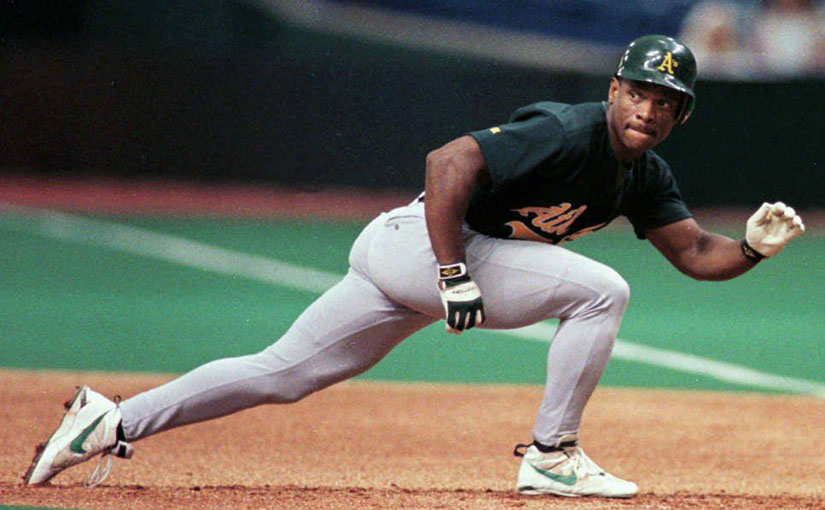
Who is the best prototype for the ideal leadoff hitter? Unquestionably, it would be Rickey Henderson. Just ask him, he’ll tell you he was the greatest of all time. Most probably, he was. In 1980, the average team got 46 steals and only 7 home runs from its leadoff slot(Lopes was an early exception). Then came Henderson. Henderson certainly stole a lot of bases, as he easily holds the all‑time record. However, he also held the record for walks (before Barry Bonds), and he hit 297 career home runs. Henderson could do it all, and in the process, he changed the idea of what a leadoff hitter could be: someone who got on base and who could hit with power. There will those that point out Ichiro, Wade Boggs or other successful lead-off hitters that were not necessarily cut from the Rickey Henderson cloth. And, I won’t argue against them, other than to say there are exceptions to all rules and my point is there are no hard and fast(see what I did there?) stereotypes for leadoff hitters.
That brings me back to Joc Pederson. Let me say first and foremost that I have no objection to Joc Pederson as a player. He hits lots of home runs, although most seem to be solo home runs. He also plays a passable defense in left or right field. I just don’t view him as a lead-off hitter. For one, he can’t hit left-handed pitching, so he will always be part of a platoon, necessitating 2 lead-off hitters. Secondly, he just strikes out too much for my taste. Yet when I compared his statistics to the above mentioned Dodger leadoff hitters yesteryear, his walks and on-base percentage are comparable to most of them. I’m not going to take the time to put forth each hitter’s statistics as time is a consideration for me in writing this article. I will concede that Joc doesn’t have as high a batting average as the others, but, I’ve learned that batting average is a statistic that’s not valued as much as it was in the past. But, for the limited number of at-bats that Joc gets, compared to the others, he scores a high percentage of runs and he has a decent On Base Percentage. His on-base percentage is surprisingly higher than Wills’ OBP. His OBP was similar to that of Furcal, it is similar to Lopes and Sax and it was similar to Brett Butler’s OBP, that is until Butler reached age 30, and he shifted things to another gear and performed much better than Pederson.
So, has this research changed my opinion on Joc Pederson as a lead-off hitter? No, I still think he strikes out too much. But I also realize that players like Rickey Henderson do not grow on trees. And, while I still hold onto a more traditional view of lead-off hitters, I’ve come to realize by looking at the stats, that Joc isn’t that terrible in the lead-off spot. He’s a far cry better than Dee Gordon for example. Presently, the Dodgers do not have a better option at lead-off. Maybe Gavin Lux or Alex Verdugo will become terrific lead-off hitters, but they’re not there yet.
Then again, the RedSox can always be so kind and send Mookie Betts our way. I wouldn’t mind George Springer either. Perhaps MLB will send him over as punishment to the Astros for their cheating ways. A man can dream, can’t he?
Guess Things Happen that Way, Johnny Cash
More from Dodger Talk

Enjoy it While You Can!
It was both surprising and not surprising to me that the Dodgers signed Kyle Tucker. That they can make it work is a tribute to the true genius of Mark Walter and Andrew Friedman. Enjoy it while you can, because it will end soon. In the upcoming CBA and talks among owners, MLB…

Dodgers Food Trailer
I did this interview a couple of weeks ago with Chef Mike, who runs the Dodgers Food Trailer for the Great Lakes Loons. They are there for every home and road regular season and playoff game. They prepare three meals a day for approximately 50 people (players and coaches). Since games end late most evenings, they do not prepare breakfast. Many of their hotels have a complimentary breakfast anyway. However,…

Meet LAD 2026 Draft Picks 1-12
3 picks were High School players (2 SS and 1 OF). There was a college OF, college catcher, college SS, and 10 college pitchers. Of all the talk for a need for a catcher, the only catcher the Dodgers selected was Luke Bard, son of LAD bullpen coach Josh Bard. Bard was a 4th year senior from Houston Christian University. He is not a prospect, so the Dodgers are still…

Interview with Paul Beachy – Team Bus Driver For The Great Lakes Loons (LA Dodgers Minor League Team)
It’s been a few days since I did this interview. We have evidently been working my son-in-law (the video guy) like a rented mule at US Water Systems. However, I am taking him to London with me in a few days, so maybe Watford will buy him a pint as a tip, but he’s a dang Red Sox fan, so there is that! I thought that it would be interesting…
Discussion (81)
Disagree, not disagreeable
I have no wisdom, conventional or otherwise. But seems to me a leadoff hitter with a high OBP and speed could not only steal a base but be a distraction for the # 2 and 3 hitters and possibly get them more fastballs. Seems to me you would want your high OBP guy batting in front of your sluggers and not behind them. We don’t have a guy like that and I know analytics doesn’t favor base stealing. They favor homers and strikeouts over singles and stealing
I, also, like a true lead off hitter with speed and the ability to steal a base now although I think Joc has done a decent job last year. Very informative article 2D2. Thank you.
Did you guys see the video of Josiah Gray on the Dodgers web page? He seems like a very bright, articulate, and decent young man.
With the additions of Nelson, Ramos, Treinen and Wood who was taken off the 40 man roster?
It’s very possible the Dodgers will coach Wood back up into being a serviceable SP and then flip him for a nice prospect. Same thing with Nelson.
But we need to remember that not all ideas are equal and some are born of necessity or desperation. Interesting piece, 2D2.
Thinking about Wood, Treinen and Nelson. If only Cole would have been injured last year then maybe AF ……..
Very thoughtful post 2d2. I’m another one who misses the old prototype of a leadoff guy even though statistically it might not be the best way to go.
Anyone know how long they have to actually add Wood to the roster?
Thank you, d2d, for the insightful column. I am hoping Lux can become our next lead-off batter.
Have you noticed the 40 man is already full? And they just signed Alex Wood! During the off season can they have more than 40, or does this mean there is a trade about to happen or a player about to be released?
One thing people overlook re homeruns and batting average. You can get 4 singles in a game and not score or you can strike out 3 times and then hit a homerun. And you score every time you hit a homerun. Not that I like strikeouts, but the first batter is batting .1000 with 4 total based and no runs, the second batter is batting .250 with 4 total based and 1 run.
Well the Dodgers added Alex Wood. Wood actually has better stats as a reliever than Will Harris whom I wanted Friedman to get. The question is will Wood take a job as a reliever.
One more move Friedman. Just one more move, get Ken Giles.