
The Rise of Baseball Cards
This is for Bear although he most likely has all of this in his data bank and more. It is a rerun of an article I posted on Think Blue LA back in December of 2012. At that time I wrote: Yesterday I spent some quality time with myself organizing and cataloging my latest Clayton Kershaw and Matt Kemp baseball cards. Today, I will take my Duke Snider cards out

This is for Bear although he most likely has all of this in his data bank and more. It is a rerun of an article I posted on Think Blue LA back in December of 2012.
At that time I wrote: Yesterday I spent some quality time with myself organizing and cataloging my latest Clayton Kershaw and Matt Kemp baseball cards. Today, I will take my Duke Snider cards out of a shoe box and place them in order, by year, in a binder. Imagine that! Duke Snider cards in a shoe box, the traditional storage place for baseball cards.
While cataloging my 2012 cards, two opposing tracks caught my attention. First, I was instantly transported back to the future experiencing my first contact with baseball cards. I could almost smell the bubble gum, feel the white powder that kept if from sticking to the cards, and I could see the cards, the 1954 Duke Snider, Ted Williams, and Whitey Ford. The 1954 Duke Snider card is my all-time favorite card. Still, I could remember the Whitey Ford card had a light blue background while the Ted Williams card had an orange background. At that time I wasn’t interested in a Ted Williams card. After all he was a Red Sox player. I can recall putting cards on our bicycle spokes, those of players in whom we were not interested, like Ted Kluszewski or Eddie Matthews – a felony offense by today’s standards. Oh, if only I had known.
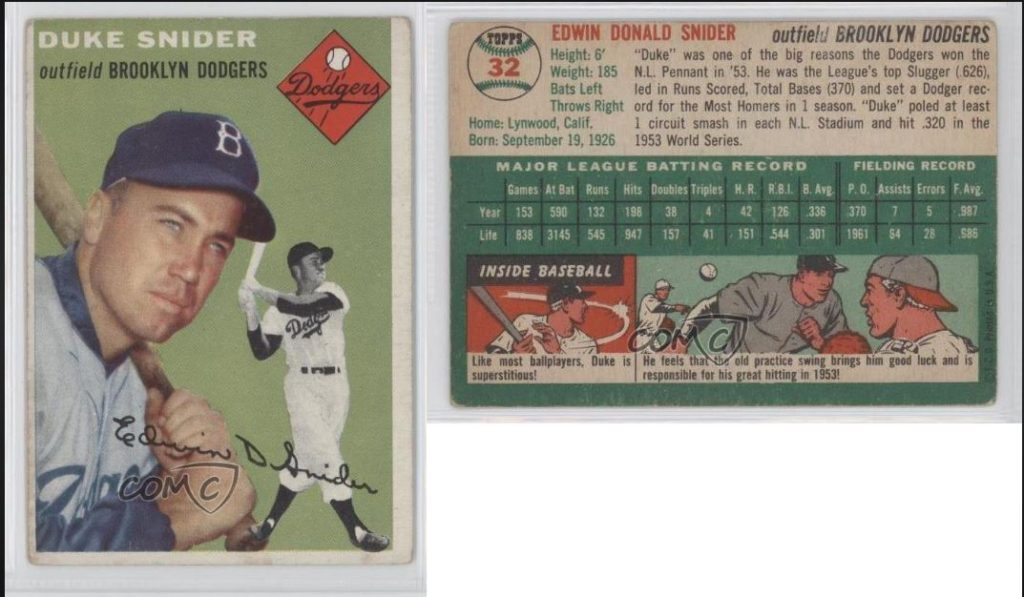
The second thing that piqued my interest yesterday was that all of the 2011 and 2012 cards were Topps cards, with the exception of six with a Bowman label. A quick check on the back of those cards revealed Bowman is registered under the Topps name. Oh yes, there was one lone Panini card. At one time the market was flooded by cards from a number of distributors: Topps, Bowman, Fleer, Donruss, Sportflics, Leaf, Upper Deck, Score. The observation regarding Topps caused me to check it out. Is the baseball card industry still flourishing?
My research sidetracked me and this post a bit (actually a lot) and led me to some of the interesting history of baseball cards and the influence they have had in North America, particularly in the United States – not only on individuals but also on the game and the economy as well. Sources point to 1868 as the birth date of baseball cards. Ironically, the baseball card (or other advertisement) was secondary and used to attract buyers of the actual product – the bubble gum or to advertise tobacco.
Peck and Snyder, a sporting goods store in New York, began producing ‘trade cards,’ not called trading cards then, featuring baseball teams in 1868. The cards were a natural vehicle for advertising. The connection between baseball teams and sporting goods was obvious, with a team image on the front and advertising on the back. Not only that, people bought the advertising. That little piece of cardboard has had a 152 year run, beginning at least forty years before any of the other major sports.
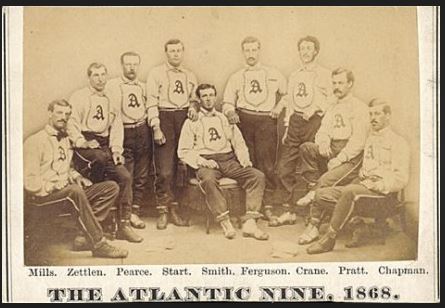
The Trade Cards distributed by Peck and Snyder are generally regarded as the first baseball cards. They were the first ‘mass produced’ advertising cards with a baseball theme. Peck and Snyder was a manufacturer of baseball equipment, and their cards featured prominent teams of the day. They are the size and style of a Carte de Viste with a paper team photograph pasted to a cardboard mount. The backs can be found with advertisement for Peck and Snyder, other companies, or are blank.
The baseball card industry, in its long history, has had a series of peaks and valleys. It played a significant part in the Great Depression for at least two industries, gum and candy makers. While we were playing with baseball cards as kids in the 1960’s, the royalties from those cards helped transform the baseball players association into one of the country’s most powerful unions. What a change that has made in the game. Some will argue for the better, while others disagree. As the royalties from those cards grew, so did the strength of the players union. Baseball cards are far from the sole source of the growth of the union but very significant at the time.
I would argue that the golden age of baseball cards was in the fifties. That most likely is simply because I was introduced to them at that time, probably in 1953. I learned that Jackie, Campy, Newk, Jim Gilliam, Joe Black were black ball players. That made no difference to me. They were ball players and more importantly, Dodgers. I imprinted on the Dodger logo like a newly hatched chicken. I traded the farm to get that Duke Snider card. Yankees to me were a throw away, fit for bicycle spokes, so I felt I had a good deal in getting a Duke card.
The baseball card industry would cite the 1980’s and 1990’s as its golden age. That is, an age of gold, as in money in the bank, not gold as a Duke Snider card in a kid’s hand. The business blossomed and flourished going through a spectacular growth bubble. It became a billion dollar a year industry. Thus was the rise of the baseball card industry from a lowly advertising tool in 1868 to an industry of which everyone wanted a part in the last two decades of the twentieth century. The story goes on, but on another day.
UPDATE
Tomorrow we will publish part 2 of this 2 part series on baseball cards.
More from Dodger Talk

Clayton Kershaw, Sandy Koufax… and Pete Rose
Yesterday, it was mentioned that Clayton Kershaw has never had Tommy John Surgery after seventeen years in the league. It was my opinion that this occurred because Clayton made a conscious decision not to throw with maximum effort on each pitch. There was a time early in his…

How Many Innings Will the Dodgers' Starters Pitch?
There are 1,458 innings in a 162-game baseball schedule. Of course, games will inevitably go into extra innings, so let’s call a season 1,500 innings (give or take). I have stated before that I would not be surprised if no Dodger starter pitched more than 125 innings. For…

Who Stays and Who Goes”?
There are thirteen pitchers who love Austin Barnes . He is an “on-the-field-pitching coach.” He is not going anywhere, so get that out of your mind. Hunter Feduccia, who happens to be LH, may or may not be a better hitter, and maybe his arm is slightly better, but he is no…

Stay Calm! All is well
The Dodgers are 8-3, and Yoshi Yamamoto just won his first win while striking out 8. Tyler Glasnow has looked like an Ace since Spring Training, and Striker Buehler, a past Ace, went 4.2 innings for OKC yesterday, allowing just two hits, walking none, and striking out six! He…
Discussion (95)
Disagree, not disagreeable
So many good posts! Badger, respect for your Vietnam service. I was a VA psychologist for a lot of years, worked with many vets with PTSD and drug addiction. A lot of good guys were still dealing it many years later. I missed serving myself by a couple of years, fortunately. Was just finishing HS when the war ended.
Mark, that must be my Koufax 1966 card you have! After Bear’s post of the other day, I went on eBay to look at Koufax cards. Might splurge and buy one. Time to complete the circle.
Happy 4th of July, everyone! May it be a safe and peaceful holiday for all of us!