
Player Profile: Yogi Berra
Berra # 8 What comes to mind when the name Yogi is mentioned? For some it is a cartoon character bear. But before that show, there was a guy named Lawrence who as a youth was tagged with that nickname. He was small in stature, but one of the best there ever would be at his given…

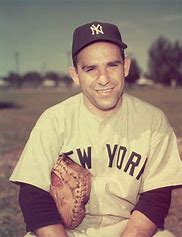
What comes to mind when the name Yogi is mentioned? For some it is a cartoon character bear. But before that show, there was a guy named Lawrence who as a youth was tagged with that nickname. He was small in stature, but one of the best there ever would be at his given craft. Lawrence Peter Berra was born in St. Louis Missouri on May 12, 1925 to Pietro and Paolina Berra. Pietro had immigrated from Italy at the age of 23 in 1909. His bride to be stayed in Italy until he could make enough money to send for her. Paolina arrived in the US on March 10, 1912 at the age of 18. She and Pietro were married 10 days later. They settled in a section of St. Louis known as ” The Hill”. The Hill was a mostly Italian neighborhood.
The Berra’s had three sons before Lawrence arrived in 1925. His given name was Lorenzo Pietro. But wishing to assimilate to their new environment he became Lawrence Peter. Since they had a hard time pronouncing Lawrence, they called him Lawdie.
Across the street from the Berra’s another Italian family lived. The Garagiola’s. They had a son, Joe, who was Berra’s age. The two would play their favorite game, baseball, together and they also loved going to movies. One day they went to see a movie that featured a Yogi, a snake charmer who wore a turban on his head. When the Yogi got up to walk, one of the boys joked that he looked like Lawdie when he walked. From that day on, Lawrence Peter Berra was known as Yogi. Even his parents would call him by his nickname.
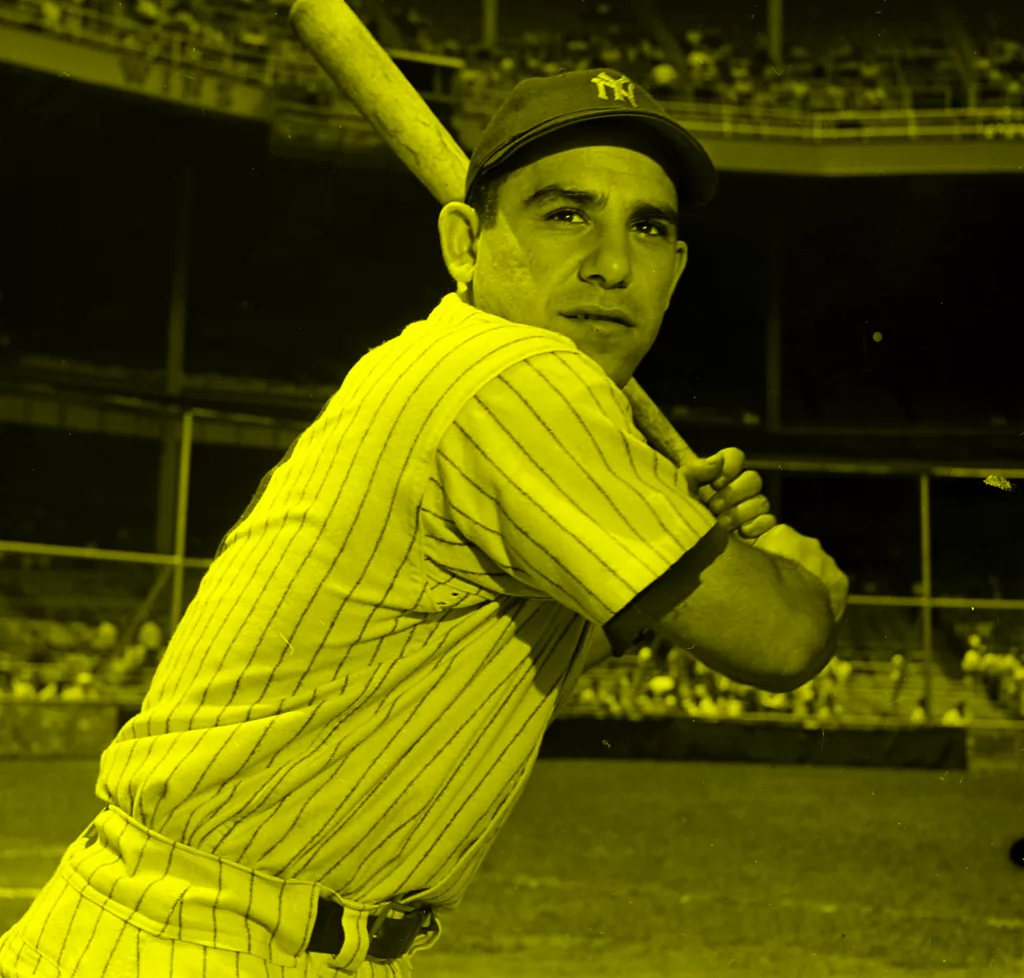
As a youth, Berra displayed the stubbornness and determination that would carry over to his playing career. This was shown when he decided to quit school after the eighth grade. His father disapproved and enlisted the aid of their parish priest to convince him to go back to school. But Yogi held firm and got a job paying 25 dollars a week in a coal yard. He was fired from that job since he regularly would leave early to go play ball. Furious that his son was fired from a job paying 25 a week, his dad got him a job driving a Pepsi truck that paid 27 a week. He was eventually fired from that job for the same reason. After much discussion, well actually argument, it was decided that Yogi could find a job that allowed him to play ball in the afternoon.
Yogi and Garagiola were stars on an American Legion team that made the playoffs two consecutive years. Garagiola was six feet tall, handsome and athletic. Berra on the other hand was 5’7″, 185. Short and dumpy and had an awkward swing where he chopped down at the ball. He would also swing at any ball in his area code. The man who ran the team, Leo Browne, arranged a tryout for his star players with the St. Louis Cardinals. Garagiola performed well and was offered a contract with a 500-dollar bonus. Although that was to be kept secret until he was 16. Both boys were 15 at the tryout. Berra was offered a contract without a bonus, and he turned it down. Rickey then offered him a 250 dollar bonus and he still turned it down. He felt he could not go home if he got less money than Garagiola in a bonus. He also tried out for the St. Louis Browns and was offered a contract with no bonus. He turned that down too.
Browne then wrote to his old friend, George Weiss. Weiss ran the Yankee farm system at the time. He explained that Berra wanted a 500-dollar bonus and whatever he made monthly was not an issue. Berra signed with the Yankees in October of 1942 for a 500-dollar bonus and 90 dollars a month. Rickey, now running the Dodgers sent a telegram to Berra offering him a chance to sign with Brooklyn. But Yogi never responded since he was property of the Yankees and he headed to Norfolk Virginia to begin his baseball career.
He had a .253/7/56 line for Norfolk in 43 in 111 games. After the season, he enlisted in the Navy. He became a machine gunner. He saw action during the D-day assault on a rocket boat prior to the troops landing. He spent 10 days on the 36-foot boat before returning to his ship, the USS Bayfield, an attack transport.
Before he was discharged, Berra was sent to the submarine base in Groton Connecticut. He played baseball there. The team’s manager, Lt. Commander, James Gleeson, a former major league outfielder, had a hard time believing that the squat, awkward-looking seaman was a professional ball player, much less one who played in the Yankee system. But in a game between the sailors and the New York Giants, Berra went 3-4 and impressed Giant manager, Mel Ott, so much he called the Yankees and offered them 50,000-dollars for him. Yankee president, Larry McPhail turned Ott down. He would later confess, he had never heard of Yogi. But if Ott thought he was worth 50,000-dollars, the Yankees should keep him. Smart move.
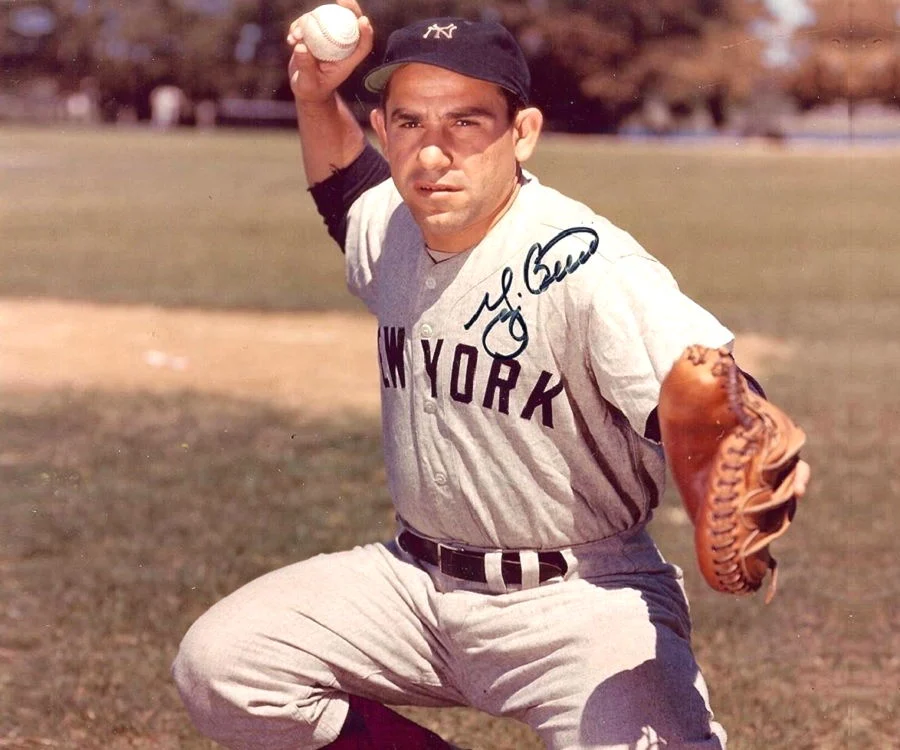
Now out of the Navy, the Yanks sent Berra to AAA Newark. The manager of the team, George Selkirk, was also skeptical that the squat young man was a ballplayer or a Yankee. He forced Berra to show him the telegram ordering him to report to the team. Berra hit .314/15/59 in 77 games. He also displayed an erratic arm behind the plate. In the last game of the season he hit a game-tying homer in the 9th in a game eventually won by Newark. The win sent Newark to the playoffs for the 14th consecutive season. They eventually lost to a Montreal Royals team that featured Jackie Robinson. Berra was called up to the Yankees and made his MLB debut on September 22, 1946 against the A’s. He went 2-4 with a homer off of Jesse Flores in his second at-bat. He hit his second homer the next day. Yogi hit .364 in 7 games.
In spring training of 1947, he played mostly in the outfield. But he was not very good out there. But he could really hit. Although he swung at a lot of pitches outside of the strike zone. Because of his erratic play in the outfield, once the season started, he played most of his games behind the plate which seemed to be the safest place for him. On June 15th he made an unassisted double play. A week later he hit his first grand slam in a win over Detroit. The next day he hit another and had six ribbies in two days.
On August 26 a group from the Hill organized a Yogi Berra night in St. Louis. Before the Yankees arrived for the series in St. Louis, Berra had contracted strep throat and had to be hospitalized. When Yogi arrived for his night he was very nervous about making an acceptance speech. That night he uttered the famous line” I want to thank everyone for making this night necessary.” The first Yogism had been spoken. Yogi had a solid .280/11/54 line in 83 games.
In the 47 World Series, Berra went 0-7 the first two games, but came off of the bench in game 3 to hit the first pinch-hit home run in series history. Berra was 3-19 in the series which the Yanks won in 7 games. In the off-season he met a pretty waitress named Carmen Short at a restaurant owned by Stan Musial. They hit it off and six months later they were engaged. On January 26, 1949 they were married in St Louis will old pal Joe Garagiola as best man.
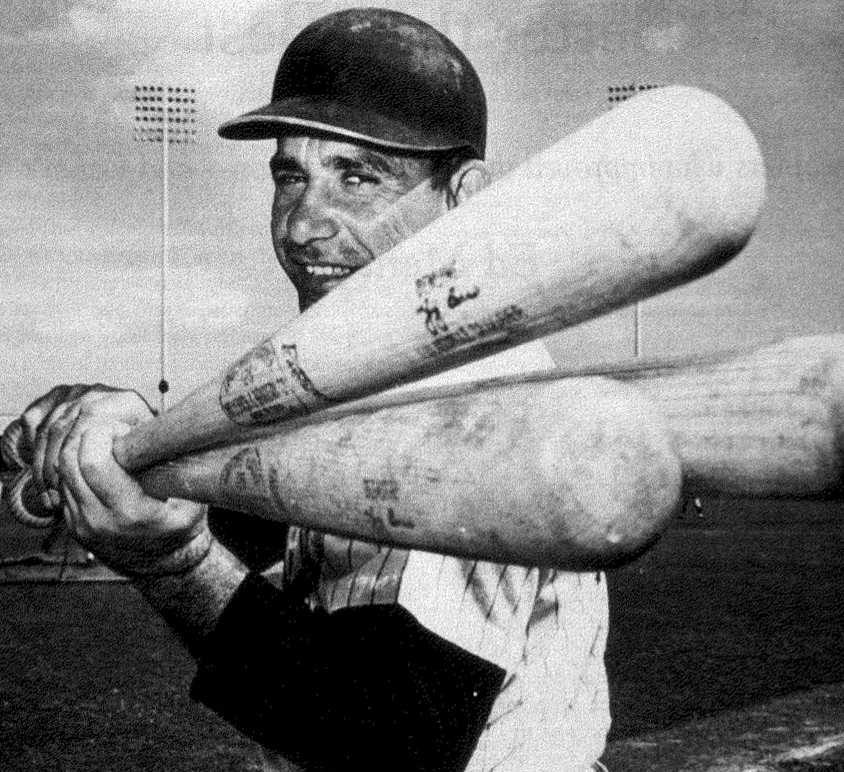
Berra had a nice year in 1948, hitting .305/14/98. He played in 125 games, 71 as a catcher. The Yankees went into the off-season seeking a better defensive catcher but that all changed when they hired the 58 year old Casey Stengel as their new manager. He nixed any talk of replacing Berra behind the plate.
Stengel took an immediate liking to Berra and called him my assistant manager. He had an idea that Yogi was more sensitive than he let on, so he had former All-Star and future Hall of Famer, Bill Dickey work with him. They spent hours working together to improve his mechanics and have him thinking ahead in games.
Despite the improvement in his defensive play, Berra still had problems with some Yankee pitchers. Notably Allie Reynolds and Vic Raschi. They thought he smothered curveballs and stabbed at fastballs, making it hard to get calls from umpires. For his part, Stengel did not entirely trust Berra either. Finally it got so bad, Stengel began calling pitches from the dugout, which infuriated the pitchers even more. It came to a head in a game against the A’s. Stengel was waving his arms trying to get Yogi’s attention. Reynolds warned his young catcher that if he looked into the dugout he would intentionally cross him up.
Berra knew it was not an idle threat and did not look into the dugout even though he could be fined. The incident marked a turning point since the pitchers now felt they could trust the young catcher. The season ended with the Yankees sweeping a two-game series with the Red Sox to win the pennant. Yogi had a disappointing series, but the Yanks beat Brooklyn in 5 games.
The next season, 1950, Yogi not only established himself as a big-league catcher, but he was also one of the rising stars in the American League. He slashed .322/28/124. He finished 3rd in the MVP vote and the Yanks won the Series again, beating the Philadelphia Whiz Kids. In 51 Yogi would win his first MVP award and help lead the Yankees to their third straight Championship. This time at the expense of the New York Giants.
52 and 53 were more of the same. Berra finished 4th and 2nd in the MVP vote and the Yanks beat the Dodgers twice for five titles in a row. Stengel and his Yanks were on a roll and Yogi was helping lead the way. A kid named Mantle was making a lot of noise in the league too. So when they left spring training in 1954 the Yanks were expecting more of the same.
But it was not to be. The Indians fielded a pretty great squad themselves with some very good pitching. But the MVP in 1954? Yogi Berra. Yogi earned his second MVP on the strength of a .307/22/125 line. The Indians fell in the series to the Yankees’ crosstown brothers, the Giants. By 1955, Yogi was the highest-paid Yankee making $48,000. and earning his third MVP award. His .272/27/108 line was not as good as 1954, but the Yanks returned to the series against their old nemesis, the Dodgers. Yogi hit ,417 in the series, but he only drove in 2 and had one homer. The one moment where he really could have affected the outcome was spoiled by one of the best catches in World Series history when his liner down the left-field line was snagged by Dodger outfielder, Sandy Amoros, and the Yanks last chance to tie or win the game was foiled.
So the Dodgers broke the spell and won their first-ever title. Happiness in Brooklyn. In 1956, the 31 year old Berra had another nice season .299/30/105 and finished second in the MVP vote to teammate Mickey Mantle who won the first of his eventual three MVP’s. Mantle was on a different planet in 1956. Yogi had a stellar series hitting .360/3/10 for the series win over the Dodgers.
Yogi turned 32 in 57. He also showed some signs of slowing down. He was in under 140 games for only the second time in 8 seasons. His BA slipped all the way down to .251/24/82. He still hit over .300 in the series, but the Yanks fell to the Milwaukee Braves in 7 games. Berra rebounded some in 58, .266/22/80, but he played in only 122 games. He did not have a very good series, but it did not matter as the Yanks rebounded to win another World Series, beating the Braves who had repeated in the National League.
Yogi reached a couple of milestones in 1959, 300 homers, and he set records, since broken, for most consecutive chances by a catcher without an error and most consecutive games without an error. The erratic catcher of the early fifties was a mere blip on the radar. The Yanks did not win the pennant in 59, but bounced back to win in 1960. They lost an exciting 7 game series to the Pirates on Bill Mazeroski’s walk-off homer. Yogi, who had been playing more left-field than catcher that season with the arrival of Elston Howard, had a birds-eye view as the ball disappeared over his head.
Yogi hung around for three more seasons. His playing time and stats steadily declining. After the World Series loss to the Dodgers in 1963, Yogi retired as an active player at the age of 38. He finished with 10 World Series wins under his belt. His final line .285/358/1430. 3 MVP awards, he was an All-Star 18 times and started for the AL 11 times. He also rarely struck out with 414 K’s in 7555 at-bats. He walked 704 times.
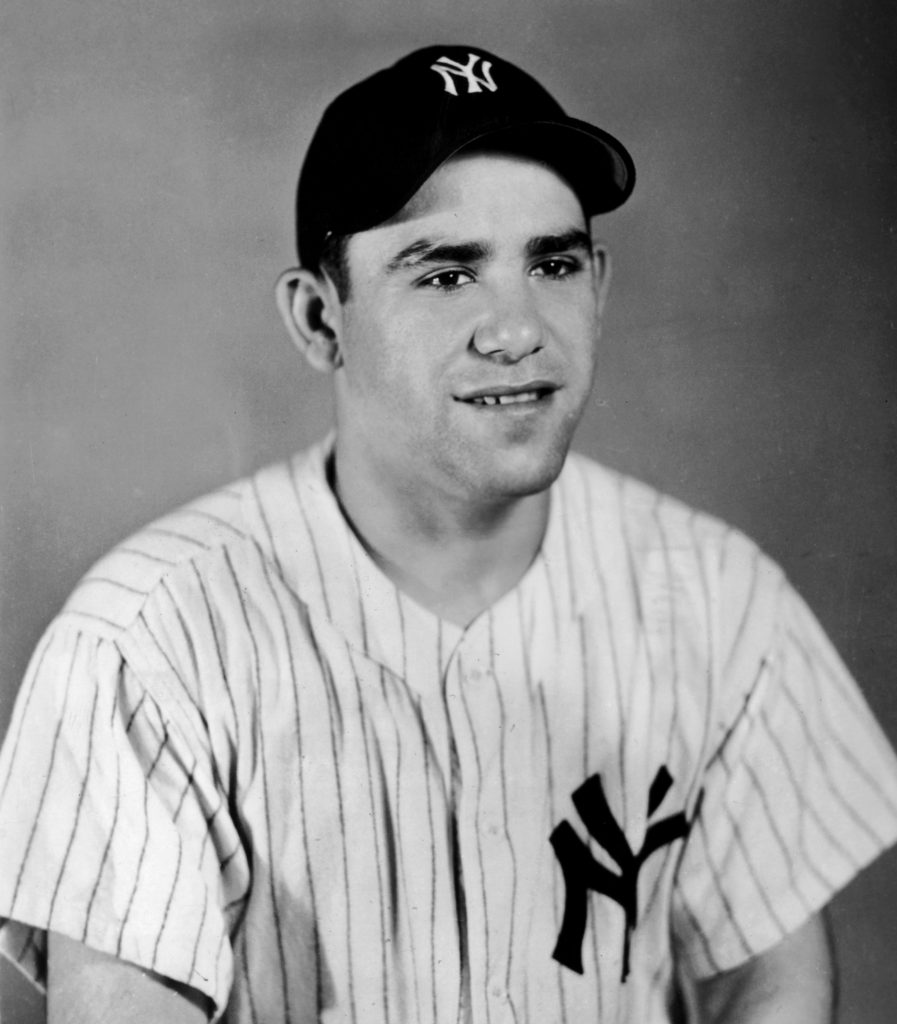
On October 24, 1963, Yogi was named the Yankee manager, succeeding Ralph Houk who had become the GM. The Yanks tried to give Yogi a 2-year deal, but he insisted on a one-year deal. He would later regret that decision. The 64 Yanks were not an easy bunch to manage. Berra wanted to keep Johnny Sain as his pitching coach, but Sain and the Yankees could not reach an agreement. So Yogi asked Whitey Ford to be a player-coach. He figured the cerebral Ford would be very good with the young pitchers.
The problem was Ford and Mickey Mantle, who was undoubtedly still the team’s biggest star, were known for their nighttime activities. and young guys like Joe Pepitone and Jim Bouton wanted to join in. The Yanks came out of the gate struggling. But by August, Yogi somehow had them in first place. Even so the Yankees were playing uninspired and inconsistent baseball. The nadir happened in Mid-August after a four-game sweep by the White Sox that dropped the Yankees 4 1/2 games back of the Sox.
After the sweep, the team bus was caught in traffic on it’s way to the airport and everyone was impatient. It was then that one of the more famous incidents occurred. Phil Linz, an infielder, pulled out his harmonica and started playing ” Mary Had a Little Lamb”. Berra heard it and yelled from the front of the bus for him to quit. It is here that what happened next depends on who you asked. Mantle said that Linz asked him what Yogi said, and Mantle said, “Play Louder” Berra heard it and stormed to the back of the bus where he slapped the instrument out of Linz’s hands. An argument ensued. Already on thin ice, Berra’s firing was considered a fait accompli. But Houk said he was not going to discuss the incident.
They lost the next two to the Red Sox but then got hot. They finished August with a rush and went 22-6 in September winning the AL pennant on the third of October. Their opponent would be the St. Louis Cardinals who had also won a tight race in the NL. The series was back and forth and came down to a seventh-game showdown between Cardinals Ace, Bob Gibson, and 22-year-old Mel Stottlemyre. The Yankee defense failed them as the Cardinals broke through for 3 runs in the 4th inning and Gibson held on to win the series. Yogi fully expected to be re-hired and get a 2-year deal, but he was fired and offered a job as a scout.
The cross-town Mets were being run by two ex-Yankees in George Weiss and Casey Stengel. With his wife pushing for a break from the Yankees after the way he was in her eyes, shabbily treated, he took the offer and joined the Mets as a player-coach. He hit .222 but only played in 4 games catching 2. He played his final game three days before his 40th birthday.
Berra was passed over three times for the manager’s job. The first time was after Stengel retired in 1965 after he broke his hip. The Mets chose Wes Westrum with Stengel’s input. Salty Parker was named interim manager after Westrum quit in 1967. In October of 1967 the Mets traded with the Senators to bring Gil Hodges in to replace Parker. Yogi respected Gil and was not upset at being passed over.
He would win his 11th ring as Gil’s coach when the Miracle Mets beat the Orioles. He would finally get the Mets job under tragic circumstances when Hodges died suddenly on a golf course in April of 1972. Although Berra coached under Hodges for four years, he was a totally different type of manager. Gil was strict, a disciplinarian. He took a very hands-on approach with his players. Yogi on the other hand treated his players like men. He expected that just playing baseball for a living would be incentive enough for a player to stay in shape and be ready to play every day. He also did not platoon, something his regulars loved. The Mets were 30-11 on June 1, but then injuries struck and they stumbled to a third-place finish. The lone bright spot for Berra that summer was his induction into the Hall of Fame. In 1973 the injury bug hit them again, and there were rumors Yogi was on his way out. But the Mets rallied and won their division with only 82 wins. They then beat the favored Reds in the NLCS and headed to the series against the A’s. Yogi became only the second manager to win a pennant in both leagues, Joe McCarthy was the other. The Mets lost in 7 games to the A’s.
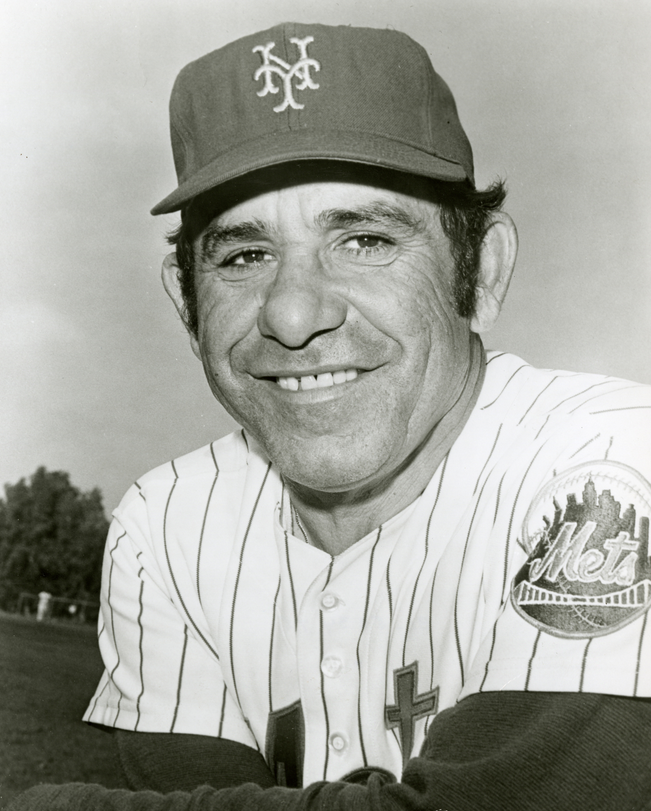
The Mets fell to 5th place with a 71-91 record in 74. Their worst finish since 1966. Simmering trouble between Yogi and outfielder Cleon Jones deepened in 75. Jones refused to enter the game as a pinch hitter and matters came to a head. Yogi refused to let him back on the team and demanded he be released. The chairman of the board, M.Donald Grant did not want to release Jones. But Yogi held firm. Soon thereafter he was released. When the team suffered a five-game losing streak in early August with a double-header shutout at the hands of the last-place Expos being the final straw, Yogi was fired and replaced by Roy McMillian.
Yogi returned to the Yankees after a 12-year absence when an old friend, Billy Martin was named manager. He would add two more World Series rings to his collection in 77-78. He got another chance to manage the Yanks in 1984. But there was no catching the Tigers who cruised to the AL pennant. There were rumors that Steinbrenner wanted to fire his manager, but he assured Yogi he would manage the entire season. Yogi was excited about the chance because the Yanks had acquired his son Dale from the Pirates.
But after the Yankees got off to a 6-10 start, he was fired. Upset that Steinbrenner had broken his promise, Yogi would stay away from the Yankees until they reconciled in 1999. He was offered the Houston job 3 days after he was fired but turned it down. He did however join the Stros as a coach for new manager Hal Lanier. Yogi remained with the Astros until 1989 finally ending his long career in uniform.
He and his wife Carmen lived in Montclair New Jersey for over a half-century. The Yogi Berra Museum was opened there. They raised three sons, Larry, a minor league catcher, Tim, who played in the NFL for the Baltimore Colts in 1974, and Dale, who spent 11 years in the majors and the last couple of months of that career with his dad in Houston as an Astro.
Yogi was not only one of the Yankee legends, he was an American Icon too. He endorsed many products including Yoo-Hoo, a chocolate drink, one of my favorites, and yes, Yogi Bear was named for him. Some of his Yogism are still quoted. One of my favorites was ” No one goes there anymore….it is too crowded”. Yogi was definitely one of a kind. He was also one of the best catchers ever. Yogi passed away on September 22, 2015, at the age of 90.
More from Dodger Talk

Enjoy it While You Can!
It was both surprising and not surprising to me that the Dodgers signed Kyle Tucker. That they can make it work is a tribute to the true genius of Mark Walter and Andrew Friedman. Enjoy it while you can, because it will end soon. In the upcoming CBA and talks among owners, MLB…

Dodgers Food Trailer
I did this interview a couple of weeks ago with Chef Mike, who runs the Dodgers Food Trailer for the Great Lakes Loons. They are there for every home and road regular season and playoff game. They prepare three meals a day for approximately 50 people (players and coaches). Since games end late most evenings, they do not prepare breakfast. Many of their hotels have a complimentary breakfast anyway. However,…

Meet LAD 2026 Draft Picks 1-12
3 picks were High School players (2 SS and 1 OF). There was a college OF, college catcher, college SS, and 10 college pitchers. Of all the talk for a need for a catcher, the only catcher the Dodgers selected was Luke Bard, son of LAD bullpen coach Josh Bard. Bard was a 4th year senior from Houston Christian University. He is not a prospect, so the Dodgers are still…

Interview with Paul Beachy – Team Bus Driver For The Great Lakes Loons (LA Dodgers Minor League Team)
It’s been a few days since I did this interview. We have evidently been working my son-in-law (the video guy) like a rented mule at US Water Systems. However, I am taking him to London with me in a few days, so maybe Watford will buy him a pint as a tip, but he’s a dang Red Sox fan, so there is that! I thought that it would be interesting…
Discussion (63)
Disagree, not disagreeable
Great job Bear. Even though I am a bon a fide Yankee Hater, Yogi is of Italian decent and one of the all time true HOFers at his position. Never seemed to strike out.
Mark, you mentioned you were a Republican yesterday, how about Ron DeSantis running for President in 2024, not Trump after we take back the House and Senate in 2022? Had to mention it. No more politics.
We made an exception and allowed a Yankee because Bear wrote an exceptional article. Very interesting!
On another subject: The Freak which is known as Oneil Cruz. The 6′ 7″ soon-to-be 24-year-old who is playing for the Pirates AAA Affiliate in Indy.
He has 191 ABs with 9 HR, 33 RBI, 11 SB, and is batting .236 with a .344 OB%. His OPS is .794 and after having 16 Errors as a SS last year, he has 14 errors this year.
He is an interesting player, but I do not think he says at SS. Try 1B!