
Chuck Connors – The Rifleman
Many can identify Chuck Connors as the “The Rifleman” but perhaps not nearly as many know he was once a Dodger and always remained a Dodger in his heart. Chuck Connors, christened Kevin Joseph Aloysius Connors, was born in Brooklyn, New York on April 10, 1921. His parents of Irish descent, Allan and Marcella Connors, had emigrated to the United States from what was then the Dominion of Newfoundland and

Many can identify Chuck Connors as the “The Rifleman” but perhaps not nearly as many know he was once a Dodger and always remained a Dodger in his heart.
Chuck Connors, christened Kevin Joseph Aloysius Connors, was born in Brooklyn, New York on April 10, 1921. His parents of Irish descent, Allan and Marcella Connors, had emigrated to the United States from what was then the Dominion of Newfoundland and now the Province of Newfoundland in Canada. Chuck had a sister Gloria who early on learned he did not like his first name. As he got older and taller he looked for a nickname, trying “Stretch” and “Lefty” but those didn’t really seem to fit. While playing first base, he would always yell, “Chuck it to me, baby, chuck it to me!” to the pitcher. The rest of his teammates and fans soon caught on and he became “Chuck”.
Chuck Connors grew up loving the Dodgers even though they were somewhat less than successful in the 1930s. Realizing he had athletic abilities he dreamed of the day he would be a Dodger. Those abilities earned him scholarships to Adelphi Academy, a private high school, and then to Seton Hall, a Catholic college in South Orange, New Jersey.
He left Seaton Hall after two years to join the army in October of 1942. He served primarily as a tank warfare instructor stationed at Camp Campbell and lastly at West Point. He was honorably discharged in 1946 and began to forge what he hoped would be a career in the world of sports.
He became a two-sport professional athlete specializing in basketball and baseball, one of a handful to ever play both sports professionally. In 1946 he played for the newly formed Boston Celtics of the Basketball Association of America. Trying to earn a living by playing two sports he would leave early in the spring for baseball spring training.
Perhaps his only claim to fame as a basketball player was that he became the first player to break one of the new glass backboards being used for the first time in professional basketball. The damage was not caused by a vicious slam dunk. He explained: “During the warm-up, I took a harmless 15 to 20 foot set shot, and crash, the glass backboard shattered.” Connors played with the Celtics during the 1946 and 1947 seasons. He then turned his attention to his first love – baseball – and his goal of becoming a Dodger.
Initially signed by the New York Yankees he was waived in 1946. He then wrote to the Dodgers asking them to acquire him. Branch Rickey agreed to sign him and he became a spring training teammate of Jackie Robinson and also his teammate for a while with the Montreal Royals before being assigned to the Newport News Dodgers. With Newport, he hit .293 with 19 stolen bases and a Piedmont League-leading 17 home runs.
In 1947 Connors helped the Mobile Bears to their first Southern Association title in 25 years while homering 15 times, six behind teammate George “Shotgun” Shuba. The following season he hit .307 with the AAA Montreal Royals with 36 doubles,17 home runs and 88 runs batted in.
The Rifleman’s dream came true in 1948 as he had made the Dodgers roster, unfortunately, it was as a first baseman behind Gil Hodges. He sat on the bench until May 1, 1949, when manager Burt Shotton called on him to pinch-hit for Carl Furillo. The story should end with a shot heard around the world. In fact, Chuck Connors said he knew he was going to crush it as he gripped the bat so tightly he was almost reducing it to sawdust. He did hit the ball hard but right back to pitcher Russ Meyer who started an inning-ending double play. That would be Connors only at-bat as a Dodger.
Shortly after that he was returned to Montreal and finished the season with the Royals hitting .319 with 20 home runs and 108 RBIs. He played with Montreal again in 1950 where his production decreased and his realization he would never be a Dodger increased. He asked for a trade. His request was granted when he and Dee Fondy were traded to the Chicago Cubs for Hank Edwards and cash. Connors could not have guessed that he now would be in competition with Fondy for the first base position with the Cubs.
During the first half of the 1951 season with the Los Angeles Angels, the Cubs top farm club, Connors excelled compiling a .321 batting average in 98 games, with 22 home runs and 77 RBIs. He was called up to the Cubs in July but hit only .239 in 66 games with just two homers and 18 RBIs. That was to mark his last appearance at the major league level as he was again assigned to the Los Angeles Angels following the season. In the meantime, Dee Fondy went on to play five years as the Cub first baseman.
Chuck Connors was soon to find his real niche in life. Hollywood came calling and he answered the call. He retired from baseball following the 1952 season and devoted his life to acting. The rest is history and Chuck Connors became synonymous with Lucas McCain, “The Rifleman.” Connors loved acting but never lost his love for baseball or the Dodgers.
Those that played with Chuck Connors remember him as much for his sense of humor and zest for life as his baseball accomplishments. On more than one occasion he was creative in running the bases following a home run. It was not unusual for him to do a cartwheel as part of his home run trot or to slide into a base, He especially loved to bait umpires and during his arguments with them, he would often use memorized passages from Shakespeare. One of his favorite passages seemed to be: “The slings and arrows of outrageous fortune I can take, but your blindness is ridiculous!” Needless to say, the surprised and perhaps confused umpires often would respond with: “You’re outta here, Connors.”
During his career, Connors was eager to bargain for what he felt was a fair wage. He didn’t always win but was not the least bit hesitant to bargain for a better deal. Tommy Lasorda who spent a number of years with Connors in the minors recounts an exchange between Connors and Branch Rickey. Rickey cautioned Connors: “Young man I don’t want you telling anyone how much money the Dodgers are paying you this year.” The young man replied: “I don’t blame you Mr. Ricky and you don’t have to worry. I’m just as embarrassed with the contract as you are.”
His negotiating skills were developing as a young man and demonstrated in 1947 when he played hard-to-get with Boston Celtics owner Walter Brown. He convinced Brown he had a deal to be a player-coach with the Birmingham team in the new Southern Basketball League. Celtics owner Brown eventually caved into Connors’ contract demands.
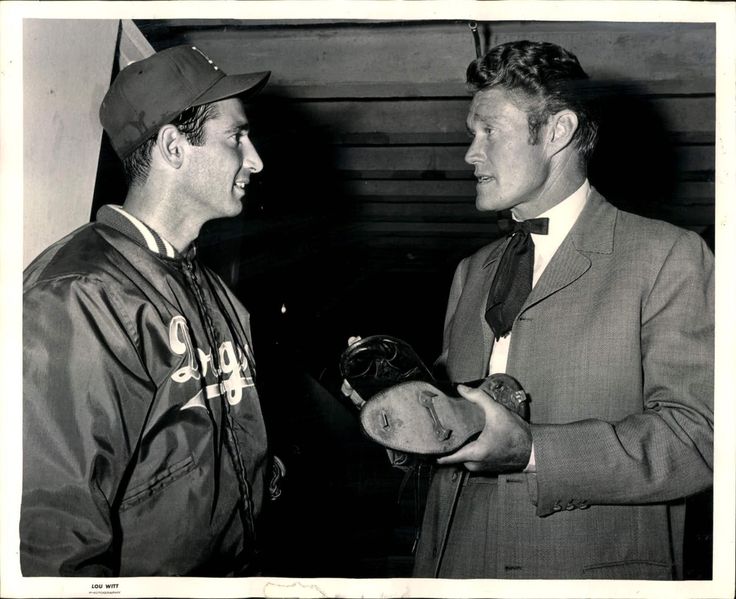
Dodger fans will remember the holdout by Sandy Koufax and Don Drysdale at the beginning of the 1966 baseball season. Most of us didn’t know that Chuck Connors played an off-field role by helping to end the celebrated holdout when he acted as an intermediary during negotiations between the team and the players. In an Associated Press photo, he can be seen with Don Drysdale, Sandy Koufax and Dodgers general manager Buzzie Bavasi announcing the pitchers’ new contracts.
The Rifleman died in 1992. Before his death, he was to have said he would rather have been Gil Hodges than Lucas McCain.
Biographer David Fury wrote that his stationary even said “Go Dodgers”, and you’d invariably find Chuck at Dodger Stadium on opening day and as often as he could make it to a ball game. The Dodger logo is etched on his tombstone as are the logos of the Cubs and Celtics.
Gun nickname trivia: On May 1, 1949, Chuck Connors (“The Rifleman”), Carl Furillo (“The Reading Rifle”) and George “Shotgun” Shuba all had plate appearances with the Dodgers. Connors and Shuba were hitless as pinch hitters and Furillo was hitless in three plate appearances. Former Dodger “Pistol” Pete Reiser was a member of the Boston Braves on that day but did not play.
More from Dodger Talk

Enjoy it While You Can!
It was both surprising and not surprising to me that the Dodgers signed Kyle Tucker. That they can make it work is a tribute to the true genius of Mark Walter and Andrew Friedman. Enjoy it while you can, because it will end soon. In the upcoming CBA and talks among owners, MLB…

Dodgers Food Trailer
I did this interview a couple of weeks ago with Chef Mike, who runs the Dodgers Food Trailer for the Great Lakes Loons. They are there for every home and road regular season and playoff game. They prepare three meals a day for approximately 50 people (players and coaches). Since games end late most evenings, they do not prepare breakfast. Many of their hotels have a complimentary breakfast anyway. However,…

Meet LAD 2026 Draft Picks 1-12
3 picks were High School players (2 SS and 1 OF). There was a college OF, college catcher, college SS, and 10 college pitchers. Of all the talk for a need for a catcher, the only catcher the Dodgers selected was Luke Bard, son of LAD bullpen coach Josh Bard. Bard was a 4th year senior from Houston Christian University. He is not a prospect, so the Dodgers are still…

Interview with Paul Beachy – Team Bus Driver For The Great Lakes Loons (LA Dodgers Minor League Team)
It’s been a few days since I did this interview. We have evidently been working my son-in-law (the video guy) like a rented mule at US Water Systems. However, I am taking him to London with me in a few days, so maybe Watford will buy him a pint as a tip, but he’s a dang Red Sox fan, so there is that! I thought that it would be interesting…
Discussion (78)
Disagree, not disagreeable
I really liked Randolf Scott & Joel McCrea in their westerns.
2 that I almost forgot and were very funny movies. Shanghai Noon, and Shanghai Knights. Jackie Chan and Owen Wilson. Both were really well done, and the out takes at the end of the movie were hilarious. It is a wonder Chan was not injured more seriously.
By the way, Connors baseball cards are not cheap. Most start around 10 bucks and go up.
Just another thought about Lou Diamond Phillips in Longmire. He did not speak in contractions. Instead of “I can’t” or I didn’t or I’m”, he always said, “I can not, I did not or I am.” Wonder if he talked like that all the time, or it was in the script written that way. Quite refreshing though.
On another note, my neighbor’s mother was Doris Baker in the “Cinder Ellers” (way before my time). Anyways, at the beginnings of The Virginian, there was a scene where a bunch of babies were laid on a bed. He was one of them. Not in the credits, but a claim to fame.